Classic Car
Add Bluetooth to an Older Car, Keep the Radio
An FM transmitter adds phone audio to any car without removing the head unit. Where an aux adapter beats it, and the frequency problem nobody mentions.
Contents
The usual advice for getting your phone's audio into an older car is to replace the radio. On a car you value for being original — a classic, or just something you would rather not start hacking into — that is the wrong first move. There is a fully reversible option that removes nothing, and it is the kind of slightly-inelegant fix this site exists for.
A note on this guide: this rests on how each injection method interfaces with an older head unit, not on installations done here. See how we test.
The reversible answer: an FM transmitter
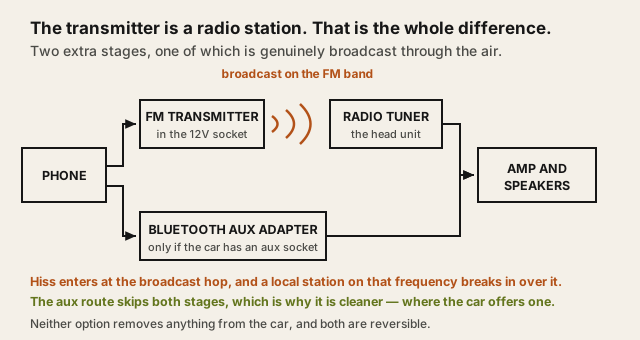
An FM transmitter is a small unit that plugs into the 12V socket, pairs with your phone over Bluetooth, and rebroadcasts the audio on an empty FM frequency. You tune the car's own radio to that frequency, and the phone plays through the existing speakers.
Nothing is removed. Nothing is wired. The original head unit stays exactly as it left the factory, and the whole modification unplugs in a second. For a car where preserving the original dashboard matters — for value, for authenticity, or just because you like it — that reversibility is worth more than a slightly cleaner signal.
This page contains affiliate links. If you buy through them, Ugly Fixes may earn a commission at no extra cost to you. Products are selected independently.
Bluetooth FM transmitter
Works on any car with a radio. Prefer one with a clear display and a physical off if your 12V socket stays live with the key out.
See current options(opens in a new tab, affiliate link)Affiliate link. Price shown on the merchant's site.
The honest hierarchy
An FM transmitter is the option that always works, not the option that sounds best. If your car offers a better input, take it.
| FM transmitter | Bluetooth aux adapter (our pick) | Cassette adapter | |
|---|---|---|---|
| Works on any car | Yes — needs only a radio | No — needs an aux input | No — needs a tape deck |
| Sound quality | FM band, some hiss | Cleanest — bypasses the radio | Middling, varies by adapter |
| Affected by local stations | Yes, the main weakness | No | No |
| Removes anything from the car | No | No | No |
| Setup | Plug in, find a frequency | Plug into aux, pair | Insert, pair |
| Best for | Cars with only a radio | Cars with an aux input | Cars with a working cassette deck |
The highlight is the best-sounding option where a car supports it. Most older head units do not have an aux input, and that absence is precisely what makes the FM transmitter the common answer rather than the ideal one.
The frequency problem nobody mentions
The one real weakness of an FM transmitter is worth understanding before you buy, because it explains every disappointing review.
The transmitter works by occupying an empty FM frequency. In a rural area with few stations that is easy; in a city, genuinely empty frequencies are scarce, and a real broadcast bleeding onto yours produces the muffled, underwater sound people complain about. The car's own ignition electronics can add noise on top.
The practical consequences:
- Find the clearest frequency for your area and set the transmitter and radio to it.
- Expect to change it on a long trip, as you move between transmitter regions and the empty frequency at home becomes an occupied one two counties away.
- A unit with a clear display makes that reselection a ten-second job rather than a fiddle.
None of this makes it unusable. It makes it a compromise, which is the honest way to describe it.
The small parasitic-draw caveat
The transmitter draws power while plugged into a live 12V socket. On most cars the socket is only live with the ignition on, so this is a non-issue. On some it stays powered with the key out, and then a permanently plugged-in transmitter is one more small load on the battery — the same standing-draw concern that flattens a stored car, covered in classic car winter storage.
If the car sits, unplug it, or choose a transmitter with a genuine physical off switch rather than one that merely sleeps.
Where this fits
It is a daily-usability upgrade for an older car, alongside the paperwork and clutter fixes in car clutter: keeping a daily driver usable and glovebox document holders. If you are adding a charger at the same time, a USB car charger with a voltage display doubles as a crude battery-health readout — useful on a car whose dashboard tells you nothing.
Questions people actually ask
What is the least invasive way to add Bluetooth to an old car?
Does it sound as good as a proper stereo?
Why does my FM transmitter sound bad in town?
When is an aux adapter the better choice?
What about a cassette adapter?
Will it drain the battery?
Does using one affect a classic car's value?
Question this page did not answer? Ask it.