Road Trip
Collapsible Traffic Cones for a Dangerous Roadside Stop
A wider base resists being blown over by passing traffic in a way a flat warning triangle cannot, and several cones can mark a taper leading up to the hazard.
Contents
A warning triangle is the default roadside visibility item, and it has one structural weakness that rarely comes up until it actually matters: a flat panel standing on a thin support is genuinely easy for passing-traffic wind-wash to knock over, right when staying upright is the entire point.
A note on this guide: this rests on published visibility and stability figures, not on cones used at a roadside here. See how we test.
Where cones actually improve on a triangle
Stability in wind. A cone's wider base and tapered shape gives it meaningfully more resistance to being blown or knocked over by the turbulence of passing vehicles than a flat triangle balanced on a narrow stand. This matters most exactly when it is most needed — a busy road, fast-moving traffic, genuinely dangerous conditions.
A taper, not a single point. Multiple cones spaced along the road ahead of a hazard create a visual taper that leads a driver's attention progressively toward the stopped vehicle, rather than a single triangle that a driver either notices in time or does not. This is the advantage a single warning device — of any kind — cannot replicate on its own.
This page contains affiliate links. If you buy through them, Ugly Fixes may earn a commission at no extra cost to you. Products are selected independently.
Collapsible traffic cones
Carry more than one — the taper from several spaced cones is the real advantage. Prioritise height and a reflective collar over how small it folds; see the size note below for what the standards actually call for.
See current options(opens in a new tab, affiliate link)Affiliate link. Price shown on the merchant's site.
The size the standards actually call for, and what you can buy
This is the part worth knowing before ordering, because there is a real gap between the two.
Highway engineering practice in the US is set out in the MUTCD, and for cones it is specific:
| Situation | Minimum cone height |
|---|---|
| Daytime, lower-speed roads | 18 inches |
| Night, or roads posted 45 mph and above | 28 inches |
At 28 inches and above it also calls for retroreflectorisation — a 6-inch white band sitting 3 to 4 inches down from the tip, and a second 4-inch band about 2 inches below that.
Two honest qualifications. The MUTCD governs work zones rather than a private driver who has broken down, so this is not a legal requirement being placed on you. And most collapsible cones sold for car boots are nothing like 28 inches — 12 to 15 is typical, which is well under the height that standard considers visible at highway speed, at night, in the conditions you are most likely to need one.
That is not a reason to skip them. It is the reason to be clear about what they are: a genuine improvement over nothing for a daytime, lower-speed stop, and materially less than the engineering standard for the night-time highway case. If your driving is mostly the latter, prioritise height and a reflective collar over how small it folds, and treat a warning triangle placed well back as doing more of the work.
What actually matters
Reflectivity, not just presence, once it is dark. A plain orange cone relies on being lit by headlights at an angle that shows it. A retroreflective collar sends light back toward the driver who supplied it, which is the property that makes a cone visible early rather than close up.
Quantity over a single "best" device. The genuine safety improvement here comes from spacing several cones to build a taper, not from cones being inherently superior to a triangle as a single item.
Storage trade-off is real. Collapsible cones pack smaller than solid ones but will not resist wind quite as well — a reasonable trade for most car boots, worth knowing rather than assuming collapsible means no compromise.
Check local requirements. Some jurisdictions specify a warning triangle for certain situations by name. Cones are a genuine safety improvement in general use; they may not substitute for a specific legal requirement everywhere.
Where to actually place them
Distance behind the vehicle should scale with how fast traffic is moving, since it is really a function of how much reaction time an approaching driver needs. As a general guide, that means a shorter distance on a low-speed residential or urban road and considerably more on a highway — driver-education material commonly cites roughly ten paces at low speed versus fifty or more at highway speed, though the practical rule is simple: the faster the traffic, the further back the first cone needs to be, not a fixed distance regardless of road type.
Where several cones are used, space them progressively further from the vehicle in the direction traffic is approaching from, not clustered close together. That progression is what actually builds the taper effect — a driver sees the first cone early, at a distance, and each subsequent one confirms and narrows their read on where the hazard is, rather than encountering the full picture all at once close up.
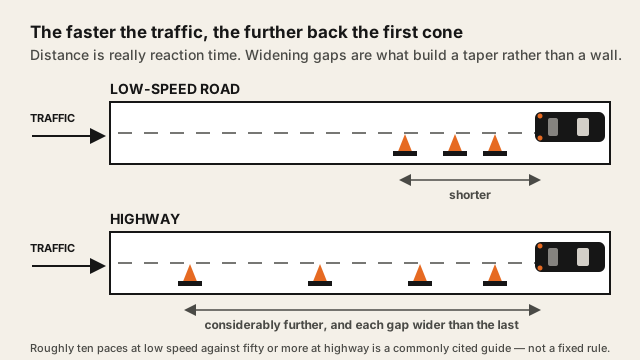
Cones clustered evenly a few paces apart read as a single object at speed, which is the failure mode worth avoiding — it gives a driver one thing to notice rather than a sequence, and at that point the extra cones have bought nothing a single triangle would not have.
The mistake to avoid
Buying one cone and expecting it to outperform a triangle on its own — the real advantage is in numbers and spacing, not the shape of a single unit. For most roadside situations, one triangle plus a couple of cones covers more genuinely different failure modes than either alone.
This sits alongside the fuller roadside-visibility kit and the LED flare vs triangle comparison as part of an older car's overall roadside readiness.
Questions people actually ask
Are traffic cones actually better than a warning triangle?
How many cones do I actually need?
Do collapsible cones stay upright as well as solid ones?
Should I carry cones instead of a triangle, or both?
Question this page did not answer? Ask it.