Workshop Tools
Nitrile vs Latex vs Vinyl Gloves for Oil Work
Only one of the three stands up to petroleum products. What thickness actually means, and the situation where wearing gloves is the dangerous choice.
Before you buy anythingThis page also considers Reusable chemical-resistant gauntlets, Barrier cream and bare hands and Mechanic's fabric gloves. Why, and when each is the better answer.
Contents
Disposable gloves are bought by price and box size more than by material, which is understandable and also why so many people conclude gloves are useless for oil work. Two of the three common materials genuinely are.
A note on this comparison: researched from published material properties and general chemical resistance behaviour rather than measured breakthrough testing. See how we test.
The short version
Nitrile. Buy this. It resists petroleum products, tolerates many solvents, punctures less readily than the alternatives and sidesteps latex allergies entirely.
Latex. Excellent dexterity, and it degrades in contact with oil. Wrong tool.
Vinyl. Cheapest, weakest, loosest. Wrong tool for anything but very light, brief, clean handling.
| Nitrile (our pick) | Latex | Vinyl | |
|---|---|---|---|
| Choose this if | Any oil, fuel or solvent work | Nothing on this page — oil degrades it | Light, brief, clean handling only |
| Resistance to oils and fuels | Good | Poor — swells and degrades | Poor |
| Resistance to many solvents | Good, formulation-dependent | Variable to poor | Poor |
| Puncture resistance | Best of the three | Good | Weakest |
| Fit and dexterity | Good, conforms with hand warmth | Best | Loose |
| Allergy risk | None of note | Natural rubber latex allergy | None of note |
| Tears during fiddly work | Least often | Sometimes | Frequently |
| Cost per box | Highest | Middle | Lowest |
| Cost per completed job | Often lowest — fewer used | Middle | Highest — you keep replacing them |
| Right for oil changes | Yes | No | No |
Why latex fails here specifically
Latex is not a bad glove. It is a bad glove for this, and the reason is chemistry rather than quality.
Natural rubber swells on contact with petroleum products. The glove absorbs oil, softens and loses strength, and it does this without necessarily tearing — so it continues to look like protection while holding a film of used oil against your skin. That is arguably worse than working bare-handed, where at least you would wash it off.
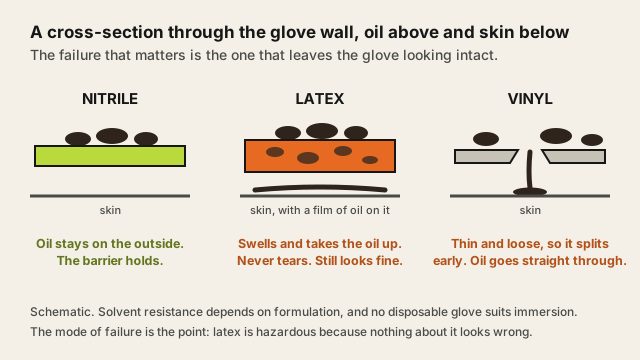
For anyone with a latex sensitivity the question does not arise at all, and nitrile removes it permanently.
What the thickness number means
Disposable gloves are specified in mils. Thin examination-grade gloves are built for feel and are the ones that split on a sharp edge under a wheel arch. Heavier mechanic-grade nitrile trades a little sensitivity for staying intact through a whole job.
For fluid work the heavier end is the economical choice even though the box costs more, because the relevant number is gloves used per job rather than gloves in the box. A thin glove that tears twice during one oil change has cost you three gloves and two interruptions.
This page contains affiliate links. If you buy through them, Ugly Fixes may earn a commission at no extra cost to you. Products are selected independently.
Disposable nitrile mechanic gloves
Disposable garage gloves. No medical or chemical-protection claim is implied — check the mil rating.
See current options(opens in a new tab, affiliate link)Affiliate link. Price shown on the merchant's site.
Where the cheapest option is genuinely enough
Vinyl is the cheapest of the three and it is not universally the wrong answer — it is the wrong answer for the job this page is mostly about.
Where vinyl is fine: dry, brief, low-dexterity work with nothing aggressive involved. Handling clean parts, sorting fasteners, keeping dye off your hands from a new steering wheel cover, anything where the glove is a barrier against dirt rather than against chemistry. It is loose-fitting and it tears easily, and for a five-minute dry job neither matters.
Where it is not: anything with oil, fuel, brake cleaner or solvent in it. Vinyl's resistance to those is poor, and a glove that degrades against what it is holding is worse than no glove, because you will not notice it has failed until your hand is wet.
There is a second, larger saving that has nothing to do with material. Thickness is routinely over-bought. A heavier glove costs more, is sold as the serious choice, and reduces the dexterity that makes you willing to keep wearing it — so for most home jobs the mid-weight box is both cheaper and the one you will actually use. The number to check is set out above.
Disposable nitrile mechanic gloves
Mid-weight covers most home jobs. Buy the larger box rather than the thicker glove — running out is what stops people wearing them.
See current options(opens in a new tab, affiliate link)Affiliate link. Price shown on the merchant's site.
Thickness is the figure this page keeps returning to, and it is the one most gloves do not publish.
AMMEX Gloveworks HD Orange nitrile gloves
AMMEX
8 mil palm and 9 mil fingertips, published — which is why it is named here. Most disposable nitrile does not state a thickness at all, and that is the number that decides whether it survives a job.
Check price and availability(opens in a new tab, affiliate link)Affiliate link. Price shown on the merchant's site.
Who should pick which
Nitrile for anything automotive. It is the default here and the reason the other two are a comparison rather than a choice.
Vinyl for dry, short, clean handling where cost per glove is the only variable that matters.
Latex for essentially nothing in a garage — the reason is set out above, and it is a material problem rather than a quality one.
The habit that makes gloves worth wearing
Gloves fail as a system more often than as a product. The common pattern: the first thing gets oily, you take the gloves off to do something delicate, and then everything you touch afterwards is contaminated anyway.
Two things fix most of it. Keep the box within reach of where you work rather than across the garage, and double-glove on messy jobs so a torn outer layer does not mean stopping. Both are cheaper than the alternative, which is spreading used oil across every tool you pick up.
Where gloves sit among the rest of the supporting kit is in oil change accessories that stop the mess, and the job itself is in changing oil without the mess.
If this is not right for you
- Reusable chemical-resistant gauntlets
- The correct answer for prolonged contact with solvents or parts washers, where a disposable glove is the wrong category of product entirely.
- Barrier cream and bare hands
- Genuinely reasonable for short jobs where dexterity matters most, and considerably better than a torn glove that traps oil against skin.
- Mechanic's fabric gloves
- Better for abrasion, impact and cold than any disposable, and useless against fluids — a different problem with a different solution.
Questions people actually ask
Which material should I buy for oil work?
What does latex actually do in contact with oil?
What is wrong with vinyl?
What thickness do I need?
Are black nitrile gloves better than blue?
Should I double-glove?
Question this page did not answer? Ask it.