Emergency & Roadside
Recovery Strap vs Tie-Down Strap: Different Jobs
A tie-down strap has no give and a recovery strap needs some — swapping one for the other is how a rigid strap snaps or a stuck car never breaks free.
Before you buy anythingThis page also considers a tow service. Why, and when each is the better answer.
Contents
Both come coiled in a similar bag, both look like a strap, and the mechanical property that makes one of them right for its job is exactly what makes it dangerous for the other.
A note on this comparison: this rests on published ratings and on what each is engineered to do, not on straps loaded here. See how we test.
The short answer
A recovery strap needs elastic give — it stretches under load and releases that energy gradually, which is what actually helps a stuck vehicle break free. A tie-down strap is built to have as little give as possible, because cargo shifting under tension is the failure it exists to prevent. Using either one for the other's job is not just suboptimal, it is a real safety hazard in the recovery direction specifically.
| Recovery strap (our pick) | Tie-down strap | |
|---|---|---|
| Choose this if | Freeing a stuck vehicle — it has to stretch | Securing cargo — it must not stretch |
| Stretch under load | Yes — by design | Minimal — by design |
| Job | Freeing a stuck vehicle | Securing stationary cargo |
| Used for the other job | Poor — too much give to hold cargo still | Dangerous — shock-loads on a sudden pull |
| Attachment point | Rated recovery point only | Rated tie-down anchor |
Why the wrong direction is the dangerous one
Using a recovery strap to secure cargo mostly just does the job poorly — cargo shifts more than it should because the strap has give built in. Using a tie-down strap to recover a stuck vehicle is the genuinely hazardous swap: with essentially no stretch, the sudden load of a vehicle breaking free transmits almost instantly through the strap and into whatever it's anchored to, which is precisely the shock-loading scenario that snaps webbing or tears out a mounting point.
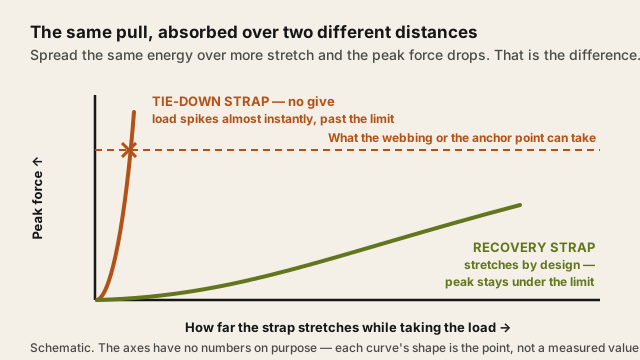
The reason is not really about the strap's rated strength — it is about distance. Freeing a stuck vehicle means absorbing a certain amount of energy, and the force required to absorb it falls the further the strap has to stretch while doing so. A recovery strap spreads that same energy over a long stretch and keeps the peak low. A strap with no give absorbs it over almost no distance at all, so the peak force has nowhere to go but up — and what fails is usually the anchor point rather than the webbing.
This page contains affiliate links. If you buy through them, Ugly Fixes may earn a commission at no extra cost to you. Products are selected independently.
Recovery tow strap
Size the minimum breaking strength to 2-3x the GVW of the heavier vehicle — see the table below. Attach only to a rated recovery point on both vehicles, never a bumper or random frame member.
See current options(opens in a new tab, affiliate link)Affiliate link. Price shown on the merchant's site.
Ratchet tie-down straps
For securing stationary cargo. Do not reach for this one to pull a stuck vehicle free — see why above.
See current options(opens in a new tab, affiliate link)Affiliate link. Price shown on the merchant's site.
Sizing a recovery strap, which is where most of the risk actually sits
Knowing you need elasticity does not tell you which strap to buy, and this is the number that decides it.
Recovery straps are rated by minimum breaking strength (MBS) — the force at which the strap fails. That is a different thing from the working load limit (WLL) you see on a tie-down strap, which is the safe load for repeated use and is set at a fraction of breaking strength. Two ratings, two meanings, and the same word "rating" on both packets.
Size the MBS against the gross vehicle weight of the heaviest vehicle involved. The common guidance from off-road clubs and recovery instructors is 2 to 3 times GVW, and some instruction is more conservative still, going as high as 5 times. That range is a genuine disagreement in the field rather than a settled figure, so the honest version is: 2–3× is the widely taught floor, and more margin is never the thing that hurts you.
| Vehicle GVW | Common minimum MBS | Comfortable |
|---|---|---|
| ~6,000 lb — most SUVs and pickups | 12,000 lb | 18,000 lb+ |
| ~8,000 lb — loaded rig | 16,000 lb | 24,000 lb+ |
| 10,000 lb+ | 20,000 lb | 30,000 lb+ |
Your GVWR is on the same door-jamb placard as the tyre pressures. Use the heavier of the two vehicles, not yours.
Stretch is a specification too. A strap or kinetic rope built for recovery is commonly around 20–30% elongation. A "tow strap" with minimal stretch and hooks on the ends is not a recovery strap regardless of how it is shelved, and that is the substitution this whole page is warning about.
Who should pick which
If the job is pulling a vehicle out of mud, snow, or a ditch, a recovery strap attached to genuinely rated points on both vehicles is the correct tool. If the job is keeping cargo from shifting in a trunk or on a trailer, a tie-down strap's lack of give is exactly what's needed. Keep both if there's any chance of needing either — they solve genuinely different problems and neither substitutes safely for the other.
For securing loose cargo specifically, bungee cords vs ratchet straps covers the lighter end of that same job, and the wider trunk-organisation picture is in car clutter and keeping a daily driver usable.
If this is not right for you
- A tow service
- The honest answer when the vehicle is stuck badly enough, or on terrain, that a DIY recovery attempt risks the vehicle or the people around it.
Questions people actually ask
Can I use a ratchet tie-down strap to pull a stuck car free?
Why does a recovery strap need to stretch?
Where should a recovery strap actually attach?
Is a tie-down strap ever the wrong tool even for its own job?
Question this page did not answer? Ask it.