Daily Driver
Are Door Edge Guards Worth the Ugliness?
A visible strip now against a chipped edge later. Where the trade works, and why the guard itself is a common cause of the damage it prevents.
Contents
Door edge guards are a trade: accept a visible strip now to avoid a small chip later. On some daily drivers that is reasonable. On a clean classic with original paint, it may be the wrong kind of prevention.
The risk is that a product bought to protect paint becomes the thing that marks it.
A note on this guide: this rests on how these attach and where the damage actually occurs, not on guards fitted here. See how we test.
Why the door edge is the vulnerable bit
The chipping is not bad luck. It is a consequence of how paint behaves.
Coatings flow away from sharp radii as they cure, so the paint film wrapping a door edge is measurably thinner than the film on the flat of the panel beside it. The edge therefore starts life with less protection than anywhere else on the car, and it is also the part that makes contact with concrete pillars, adjacent cars and garage walls.
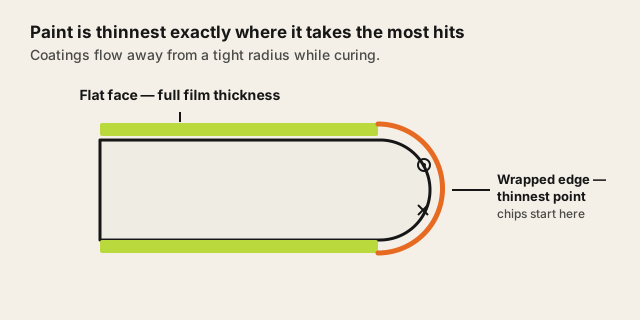
Thin paint plus the highest impact probability on the vehicle is why this specific spot needs a product when the rest of the door does not.
How the guard becomes the problem
This is the failure worth understanding before buying, because it is common and slow.
A clip-on U-channel guard grips the edge without adhesive, which sounds ideal. It also creates a narrow enclosed channel sitting directly on the most vulnerable paint on the car, and that channel collects water and grit. Moisture that cannot dry, held against thin paint, with abrasive particles in it and a door flexing the joint daily, is a recipe for exactly the damage the guard was bought to prevent — except now it is hidden.
An adhesive strip avoids the channel, and moves the problem to removal. Aged adhesive on thin edge paint can lift lacquer when it finally comes off, and paint under a strip for several years will have weathered differently from the paint around it.
Neither type is disqualified by this. But it means the honest version of the product is one you clean underneath periodically, rather than fit and forget.
This page contains affiliate links. If you buy through them, Ugly Fixes may earn a commission at no extra cost to you. Products are selected independently.
Removable car door edge guards
Removable door-edge protection category. Clean thoroughly and avoid permanent claims.
See current options(opens in a new tab, affiliate link)Affiliate link. Price shown on the merchant's site.
When it makes sense
It makes most sense on a daily driver parked in tight spaces, where a visible strip is less annoying than repeated chips. It makes least sense on a car where originality, paint condition or aesthetics matter more than parking-lot resilience.
The dividing question is what you would rather explain: a chipped edge, or a strip someone will ask about. On a car doing supermarket runs for a decade, the strip wins easily. On something being assessed for originality, it does not.
Fitting it without causing the problem
If you decide the trade is worth it:
- Clean the edge properly first, and let it dry completely. Anything trapped at installation stays there for years, working against the paint every time the door flexes.
- Fit in reasonable temperature. Adhesives do not bond well in cold, and a strip that lifts partway is worse than none — it holds water in a pocket.
- Check underneath periodically. For clip-on types this means removing them occasionally, rinsing the channel and the edge, and refitting dry.
- Do not stretch the strip to fit. Tension makes it creep back over time and lift at the ends.
Where to go next
The same trapped-grit principle governs a lot of paint damage that people attribute to bad luck — see magnetic fender covers can protect paint or mark it for the engine-bay version, and microfiber drying towels vs bath towels for the version that happens every wash.
For where this sits among the other small daily-driver products, see ugly daily-driver products that earn a place.
Questions people actually ask
Can door edge guards damage paint?
Why does a door edge chip in the first place?
Are the clip-on or adhesive types better?
What happens when I remove them years later?
Do they affect a classic car's value?
Is there a version that does not involve a strip?
Question this page did not answer? Ask it.