Detailing & Cleaning
Stone Chips and Light Scratches: What Actually Fixes Each
A fingernail test tells you which product applies — a touch-up pen for a chip caught before it rusts, a compound only for a scratch confined to the clear coat.
Contents
A stone chip and a light scratch get treated as the same minor cosmetic problem, and they need genuinely different products — using the wrong one does not fix the damage, and in the chip's case can actively make it worse.
A note on this guide: this rests on how paint layers are built and which damage reaches which layer, not on panels repaired here. See how we test.
The test that tells you which product you need
Run a fingernail gently across the damage. If it glides over smoothly, the damage is likely confined to the clear coat — a scratch-removal compound, a mild abrasive, has a genuine chance of buffing it out by hand. If the nail catches or snags on an edge, the damage has gone through the clear coat into the base colour or primer beneath, and no compound removes that regardless of effort — that needs actual paint.
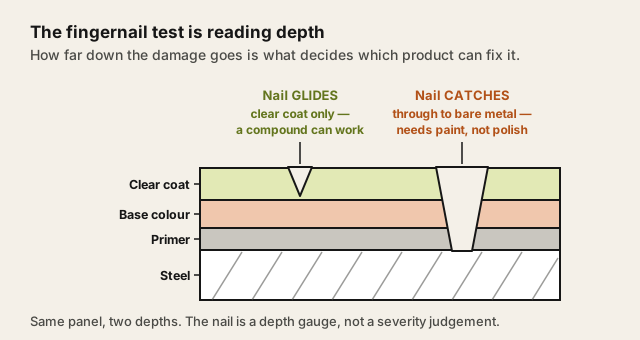
What the nail is actually doing is measuring depth. Paint is not one coating but a stack — primer, base colour, then clear coat on top — and the only question that matters is how many of those layers the damage has gone through. A compound works by removing a small amount of clear coat to level the surface around a scratch, which is why it has nothing to work with once the damage is deeper than that layer.
Stone chips: the rust risk that matters more than the look
A touch-up pen prevents rust — but only if applied before rust has already started. A fresh chip with bare metal exposed is a race against corrosion; painting it promptly seals that exposed metal back off from moisture. Once rust has already taken hold under a chip, painting over it does not stop anything — it traps the corrosion under a fresh layer of paint, where it continues spreading invisibly rather than staying visible where you can keep an eye on it.
This page contains affiliate links. If you buy through them, Ugly Fixes may earn a commission at no extra cost to you. Products are selected independently.
Touch-up paint pen
Find your car's paint code before ordering — see the table below. A pen bought by colour name rather than code is usually more visible than the chip. Apply promptly on a fresh chip, before any rust starts.
See current options(opens in a new tab, affiliate link)Affiliate link. Price shown on the merchant's site.
Buy by paint code, never by colour name. This is the step that decides whether a touch-up pen is even approximately right, and it is the one most people skip. "Silver" is not a colour; a manufacturer may have run several silvers in the same model year, and the pen matched to the wrong one is more visible than the chip was.
The code is on a sticker or plate, usually in the driver's door jamb. What it is labelled varies by make, which is why people look and fail to find it:
| Make | Where and what to look for |
|---|---|
| Toyota, Lexus | Door jamb, next to C/TR (colour/trim). Usually three characters — 1C0, 040 |
| Ford | Door jamb, shown as EXT PNT or "exterior paint". Usually two characters |
| Chrysler, Dodge, Jeep, Ram | Door jamb, three characters typically starting with P — PSB, PW7 |
| Honda, Acura | Driver's door frame. Four to seven characters, often prefixed NH- or YR- |
| GM | Door jamb "Service Parts Identification", or the glovebox. After BC/CC |
| Volvo | Door jamb, or under the bonnet on the driver's-side strut tower |
If the label is missing or unreadable, a dealer parts desk can look the code up from the VIN. Doing that costs a phone call and is considerably cheaper than a pen in the wrong silver.
Colour match is an approximation even with the right code. Paint fades with age and sun exposure, so a factory-correct code matched against ten-year-old paint will still be slightly off. Even a well-executed touch-up is usually visible on close inspection. Its real value is rust prevention on bare metal, not a factory-quality colour match — set that expectation before starting.
Build it up in thin layers. One thick application is more likely to run or sit unevenly than several thin coats applied with patience.
Light scratches: only if the fingernail test passes
Scratch-removal compound
Only for scratches that pass the fingernail test — a mild abrasive cannot fix damage that reaches base colour or primer.
See current options(opens in a new tab, affiliate link)Affiliate link. Price shown on the merchant's site.
A scratch confined to the clear coat responds well to a compound worked in by hand or with a light machine polisher — it is genuinely removable damage, not just concealable. A scratch that has gone deeper needs the same treatment as a stone chip: paint, not polish.
The mistake to avoid
Treating either product as capable of more than it is — a compound on a scratch that has already gone through to primer, or delaying touch-up paint on a fresh chip until rust has already set in underneath. Both mistakes turn a small, fixable cosmetic issue into a larger one.
If the chip or scratch has already progressed to visible rust, removing and preventing surface rust is the next guide, and if the damage came from something adhesive-related rather than an impact, removing stickers and glue without scratching paint covers that specific cause instead.
Questions people actually ask
How do I tell if a scratch is only in the clear coat?
Does touch-up paint stop rust that has already started?
Will a touch-up pen give an invisible repair?
How should touch-up paint actually be applied?
Question this page did not answer? Ask it.