Small Garage
When the Car Fits but the Tailgate Does Not
The length and width both check out and the boot still will not open. What to measure with the garage door open, and which way round the car should face.
Contents
Length and width are measured along the floor, and nothing that collides in a tight garage travels along the floor. A tailgate swings. The garage door swings. Both of them sweep through arcs that a tape measure laid across the slab never sees, which is why a car can fit a garage on paper and still be unable to open its boot.
The fix is almost never a product. It is measuring the right thing, then deciding where the car stops and which way round it faces.
A note on this guide: this rests on the geometry of how tailgates and garage doors are hinged, and on published vehicle and door-mechanism behaviour, rather than on cars assessed here. Dimensions vary enormously between models — measure your own. See how we test.
The problem, as it appears
The car goes in. The doors were sorted weeks ago with padding at the right height. Then you go to put something in the back, lift the tailgate, and it stops with a knock about two-thirds of the way up.
Or the subtler version: it opens fully, and there is now no floor left to stand on between the open panel and the back wall, so you are loading a car at arm's length from the side.
Why measuring the car and the garage disappoints
Because both measurements are of things at rest, and the whole problem is about things in motion.
A tailgate hinged at the back of the roof rotates about that hinge. Its free edge — the bottom lip when the tailgate is shut — travels up and back, and at full open the panel sits above the roofline. So the clearance it needs is height and depth at the same moment, at a point that is not above the bumper and not above the roof but somewhere between them.
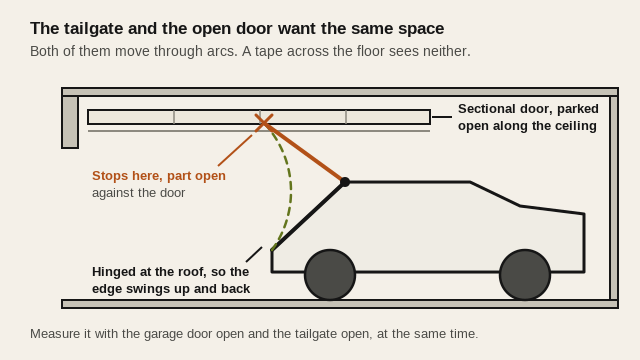
And the thing it hits is usually not the ceiling. It is the garage door, which stopped being a flat panel in the opening the moment you pressed the button.
What actually matters
1. Which panel you actually have
The single biggest variable, and it is decided at the showroom rather than in the garage.
A saloon boot lid is hinged near the rear shelf and opens over the boot aperture. It rises modestly and sweeps barely at all. A hatchback, estate or SUV tailgate is hinged at the roof and does both — up past the roofline, and back over where you are standing.
Two cars of the same length can therefore need completely different amounts of room, which is why "will it fit" cannot be answered from the length figure in a brochure.
2. The garage door is part of the envelope
The one almost nobody counts, because when you are measuring, the door is usually shut.
- A sectional door curves up and runs back along the ceiling on tracks. It occupies the ceiling plane for a good part of the garage's depth, and its tracks and the opener rail hang below it.
- An up-and-over door swings its panel outward and then parks it horizontally inside, near the ceiling at the front of the bay.
- A roller door coils into a drum above the opening. It costs headroom at the opening and leaves the ceiling clear behind it, which for this particular problem is the kindest of the three.
The usable height is not the ceiling height. It is the ceiling height minus whatever the door does when it is open, measured to the lowest thing in the path — panel, track, opener rail or light fitting, whichever hangs down furthest.
3. The opening is lower than the ceiling
Always, and often by more than people expect, because the mechanism lives in the gap between them.
This is the measurement that governs anything on the roof. Bars, a box, a bike, a tall aerial: all of them are checked against the opening, not against the interior. A car that would sit perfectly happily inside the garage can still fail to get through the hole. If what goes up there is still an open question, a roof box against a towbar carrier covers what each costs you.
4. Where the car stops, which is the only variable you control
You cannot move the ceiling and you are not going to re-hang the tailgate. The stopping point is the whole adjustment, and it has to repeat.
Moving the car forward buys tailgate clearance until the nose runs out of room, and that is the balance to find. Finding it once is easy; hitting it every time is the part that needs hardware, and it is the same hardware the parked position problem calls for.
5. Room for a person, not just the panel
A tailgate that clears the ceiling but leaves nowhere to stand has not solved the problem.
Measure for the person too: enough floor to stand square to the opening, with room to bend and lift. The panel clearing by a centimetre and a human being unable to get underneath it is a common and thoroughly miserable outcome.
The options, and who each suits
This page contains affiliate links. If you buy through them, Ugly Fixes may earn a commission at no extra cost to you. Products are selected independently.
Lower the tailgate's opening height, if the car has a powered one. Many offer a settable maximum open height, and a low garage is precisely why that setting exists. Free, reversible, and the first thing to try — check the vehicle settings menu before buying anything at all.
Turn the car round. Reversing in moves the tailgate to the back of the garage, where the ceiling is usually clear of the door gear. It costs you depth behind the car, so it suits a garage that is short of height rather than short of length. It also changes several other things at once, which getting in and out when the doors barely open goes through.
Measure properly first. A tape works across a floor and is awkward overhead, alone, against a dark ceiling, which is exactly the measurement this problem turns on.
Laser distance measure
For the overhead and behind-the-car measurements a tape makes difficult on your own. Check it reads from the back edge of the body as well as the front — measuring a garage means standing against a wall.
See current options(opens in a new tab, affiliate link)Affiliate link. Price shown on the merchant’s site. Every link here is re-checked automatically each week — one that breaks, or that lands on a storefront page instead of the product, fails that check.
Fix the stopping point so the clearance you found is the clearance you get every time.
Hanging parking position guide
A marker that touches the windscreen at the right moment. No power, nothing to calibrate, and it keeps working when the battery in the clever version has died.
See current options(opens in a new tab, affiliate link)Affiliate link. Price shown on the merchant’s site. Every link here is re-checked automatically each week — one that breaks, or that lands on a storefront page instead of the product, fails that check.
Rubber parking stop block
Fixes the front wheels rather than the whole car, so it suits a garage where the limit is at the nose. Confirm it suits your floor — fixing into the slab is a different job from sticking it down.
See current options(opens in a new tab, affiliate link)Affiliate link. Price shown on the merchant’s site. Every link here is re-checked automatically each week — one that breaks, or that lands on a storefront page instead of the product, fails that check.
See the gap you are judging, if the reference has to be behind the car rather than in front of it.
Convex garage clearance mirror
Useful when what you need to watch is at the back and you are looking forward. It shows you which thing is close, which a sensor that beeps at everything in a cluttered garage does not.
See current options(opens in a new tab, affiliate link)Affiliate link. Price shown on the merchant’s site. Every link here is re-checked automatically each week — one that breaks, or that lands on a storefront page instead of the product, fails that check.
Accept it and load from the side, if nothing above gets you there. In a genuinely short garage this is sometimes the honest answer, and the rest of the bay is better spent on the things a small garage makes worse.
The mistake to avoid
Measuring with the garage door shut. It is the natural way to measure and it describes a state the garage is never in while the car is moving. Every figure that matters here is taken with the door fully open and, ideally, the tailgate fully open at the same time.
The second mistake is solving it by creeping the car forward until the tailgate clears, without checking what the nose has lost. Clearance at the back came from somewhere, and the thing it came from is usually the room you needed to walk round the front — which is its own problem, covered in working on the side of the car you cannot reach.
Questions people actually ask
Why does the tailgate hit something when the car clearly fits?
Does the type of garage door change this?
Is a saloon better than a hatchback for this?
Should I park nose-first or reverse in?
Can the tailgate opening height be changed?
What about a roof box or roof bars?
Is there room to actually stand beside the open tailgate?
Question this page did not answer? Ask it.