Workshop Tools
The Unexciting Product That Stops Cars Moving
Wheel chocks resist rolling and support nothing. Which wheels to chock, why size decides whether they work, and the storage job they quietly enable.
Contents
Wheel chocks are not exciting enough to be bought until the day a parked car moves slightly and everyone in the garage becomes very quiet.
They do one job: resist rolling. That job is narrower than people sometimes make it, and the limits matter.
A note on this guide: this rests on how chocks are rated and where the load actually goes, not on chocks tested here. See how we test.
What they do and what they emphatically do not
A chock is a wedge that blocks rotation. That is the entire mechanism.
It does not hold weight. It does not stabilise a car on a jack. It does nothing about a vehicle tipping, sliding sideways, or coming off a stand. Every year people conflate "the car cannot roll" with "the car is safe to get under", and those are unrelated statements.
The correct framing is that chocks remove one specific failure — the car rolling off the jack or down a slope — from a list of several. Stands, ramps or a lift address the others, and nothing on this page substitutes for them.
Where chocks help
They help when a car is parked on a slight slope, when you are loading or unloading, when the hand brake is weak, or when a car is being stored and you do not want the brake left clamped for months.
They are also a useful habit any time a wheel is off the ground, because the car can move in ways the person working on it did not plan for.
Which wheels, and which side
The rule is short: chock the wheels that stay on the ground, at the far end from the lift.
- Lifting the front → chock the rear wheels.
- Lifting the rear → chock the front wheels.
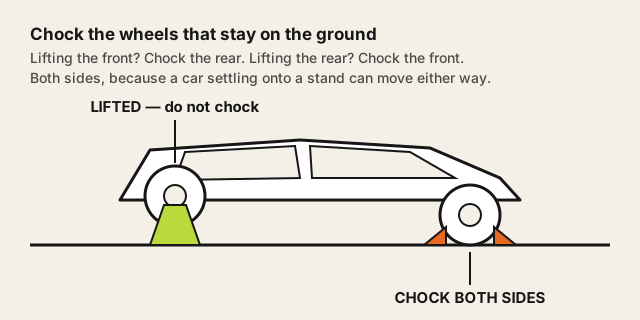
On a level floor, place chocks on both sides of the same wheel. A car settling onto a stand can shift in either direction, and blocking only the downhill side assumes you have correctly identified which way "downhill" is on a floor that looks flat.
On a slope, the downhill side is doing the real work — but the second chock costs nothing and removes the assumption.
This page contains affiliate links. If you buy through them, Ugly Fixes may earn a commission at no extra cost to you. Products are selected independently.
Rubber wheel chocks
Generic rubber wheel chocks. Use as rolling prevention, not vehicle support.
See current options(opens in a new tab, affiliate link)Affiliate link. Price shown on the merchant's site.
What to choose
Rubber usually grips better on concrete than hard plastic. Size matters: a tiny chock behind a large tire is more reassuring than effective. A rope or handle is useful because chocks migrate to the back of shelves when they are annoying to retrieve.
The size point, properly
A chock works by presenting a slope the tire cannot climb. If it is too short, the tire simply rolls over it or pushes it along the floor — and the failure is sudden rather than gradual.
The useful test is where the chock contacts the tire. It should meet the tire well up the curve, not merely touch near the ground. Small chocks sized for a trailer look adequate behind a car tire and are not, and the mismatch is worst on anything with large-diameter wheels.
The number the industry uses: chock height of roughly a quarter of the tire's overall height. A 28-inch tire wants a chock around 7 inches; a 34-inch tire wants closer to 8.5. Below about a quarter, the tire has enough leverage to climb or shove the chock rather than being stopped by it.
Two adjustments worth knowing:
- Width matters as well as height. The chock should be wider than the tire's contact patch so it bears across the tread rather than digging into one edge of it.
- A slope raises the requirement sharply. A common working rule is to add roughly half again to the chock height for every 5 degrees of grade — so a car on a 10-degree slope needs substantially more chock than the same car on the level, not the same chock used more carefully.
The tire's overall height is the figure to measure, not the wheel diameter — a 17-inch wheel with a tall sidewall is a considerably bigger tire than the number on the rim suggests.
The floor matters as much as the chock
A chock relies on friction against the ground to stay put. Concrete dusted with grit, a floor with oil on it, or loose gravel all reduce that dramatically, and a chock that slides is not a chock.
Sweep the contact area first. If the garage floor is permanently dusty or damp, that is a separate problem worth addressing — see protecting a garage floor with an oil drip mat.
The storage job people miss
The most valuable routine use of chocks has nothing to do with jacking.
A handbrake left engaged for months in a damp garage can seize, with the shoes bonding to the drum. Chocking the wheels and leaving the brake off removes that risk entirely, for the cost of the cheapest item in the garage. It is one of the genuinely free wins in a winter lay-up, covered in full in classic car winter storage.
Where to go next
For floor discipline and storage in a small garage, see how to organize tools in a one-car garage. If the job the chocks are enabling is an oil change, the mess side of it is in changing oil without the mess, and the comfort side — which matters more than people admit for low work — is in the mechanic's rolling stool.
Questions people actually ask
Are wheel chocks enough for working under a car?
Which wheels should I chock when lifting one end?
One chock or two?
Does chock size actually matter?
Rubber or plastic?
Can I leave the handbrake off if the wheels are chocked?
Question this page did not answer? Ask it.