Battery & Electrical
Battery Terminal Brush: The Cheap Starting Fix
Corroded terminals add resistance exactly where cranking current is highest. What a brush fixes, what it cannot, and the order to disconnect in.
Contents
Battery terminal brushes look like something from the bottom drawer of a hardware shop, which is about right. The job is simple: expose clean metal on the battery post and clamp so starting current does not have to pass through corrosion.
The temptation is to oversell it. Do not. This is not a magic starting fix. It is a cheap way to remove one common, visible fault before chasing more expensive ones.
A note on this guide: this rests on how corrosion raises resistance at a joint, not on terminals cleaned here. See how we test.
Why this matters more than it looks
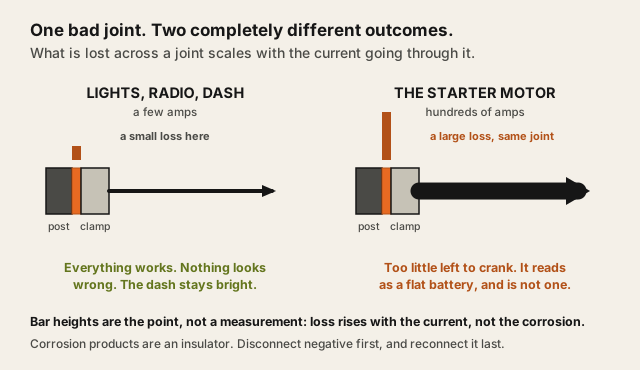
A starter motor draws hundreds of amps. Everything else in the car draws single or double digits.
That difference is the whole argument. Resistance that is completely irrelevant to a headlight becomes decisive at the current a starter demands, because the voltage lost across a bad joint scales with the current passing through it. A connection that runs your lights, radio and dashboard without complaint can still be unable to crank an engine.
This is why the classic symptom is so specific: everything electrical works, the dashboard stays bright, and the engine turns slowly or not at all. People read that as a flat battery. Often it is a bad joint between a perfectly good battery and the cable.
Where the corrosion comes from
Lead-acid batteries vent a small amount of acidic vapour in normal use, and more when charging hard. That vapour condenses around the post seal and attacks whatever it lands on — the lead post, the clamp, and if it gets far enough, the copper strands inside the cable.
The furry white or green growth is the product of that reaction. It is also an insulator, which is the part that matters.
When a brush is the right answer
It helps when there is white or green corrosion on the post, when the clamp has a dull oxidised inner surface, or when a car has intermittent electrical oddness after sitting.
High current does not tolerate poor contact. A connection that is adequate for lights can be inadequate for a starter motor.
When it is not
A brush cleans surfaces. It does not fix:
- A tired battery. Clean terminals on a sulfated battery give you a well-connected flat battery.
- A bad earth strap. The return path matters exactly as much as the feed, and the strap from engine or gearbox to body is a common failure on older cars — often corroded at the body end where nobody looks.
- Corrosion inside the cable. If green has wicked up under the insulation, the cable is the fault and cleaning the visible end achieves nothing.
- A stretched clamp that no longer grips the taper.
This page contains affiliate links. If you buy through them, Ugly Fixes may earn a commission at no extra cost to you. Products are selected independently.
Battery terminal cleaning brush
Generic battery terminal cleaning brush. Disconnect safely and know your radio/security codes first.
See current options(opens in a new tab, affiliate link)Affiliate link. Price shown on the merchant's site.
Doing it in the right order
The sequence matters more than the technique, and it is the part people improvise.
- Note your radio and security codes before disconnecting anything. On some cars this is trivial; on others it is an afternoon.
- Negative terminal off first. With the earth removed, a spanner brushing bodywork while you work on the positive cannot complete a circuit.
- Positive terminal off second.
- Neutralise, then clean. A weak solution of baking soda in water neutralises acid residue and makes the mess safe to wipe away. Keep it out of the cells.
- Brush the post and the inside of the clamp until both show bright metal. The inner face of the clamp is the surface that does the work and the one most often skipped.
- Reconnect positive first, negative last — the reverse of removal, for the same reason.
- Protect after tightening, never before. Grease or a terminal spray on the outside of the finished joint seals it from vapour without insulating the contact.
If corrosion returns quickly, look deeper
Recurrence is information. A terminal cleaned properly should stay clean for a long time, so a post that furs up again within weeks is telling you something is producing acid vapour faster than normal.
Overcharging is the common cause on an older car with an unregulated or failing alternator, and it is measurable: check charging voltage at the battery with the engine running. A leaking post seal or a hairline crack in the case around the post is the other candidate, and that is a battery replacement rather than a cleaning job.
Where this fits in a starting problem
Clean the terminals early, because it is quick and free and eliminates a real variable. Then work outward: battery condition, earth strap, cable integrity, starter.
If the car sits between drives, the battery is the more likely culprit and the fix is upstream — preventing a dead battery in winter storage covers measuring the parasitic draw, and best battery maintainers for classic cars covers what to leave it on.
If the engine is large and cranks slowly even on a good battery, terminal resistance is worth eliminating before concluding you need a bigger jump pack — see compact jump starters for a V8 classic.
Questions people actually ask
Can dirty battery terminals stop a car starting?
Which terminal should I disconnect first?
What does the colour of the corrosion tell me?
Should I put grease on the terminals?
How tight should the clamp be?
The corrosion keeps coming back. What now?
Question this page did not answer? Ask it.