Emergency & Roadside
Car Escape Tools: The Detail That Decides It
A window breaker will not touch a laminated windshield, and may not touch newer side glass. What it does break, why spring-loaded wins, and where to keep it.
Contents
A car escape tool is a seatbelt cutter and a window breaker in one small unit, and it is genuinely worth carrying. It is also sold with a dangerous piece of unspoken misinformation: the picture of someone smashing a windshield. You cannot break your windshield with it, and in a growing number of cars you cannot break some of the side windows either. Knowing exactly what it does — and does not — is the difference between a tool that saves you and one that fails at the worst moment.
A note on this guide: this rests on how these tools work and which glass they can break, not on tools used in an emergency here. See how we test.
The glass it cannot break
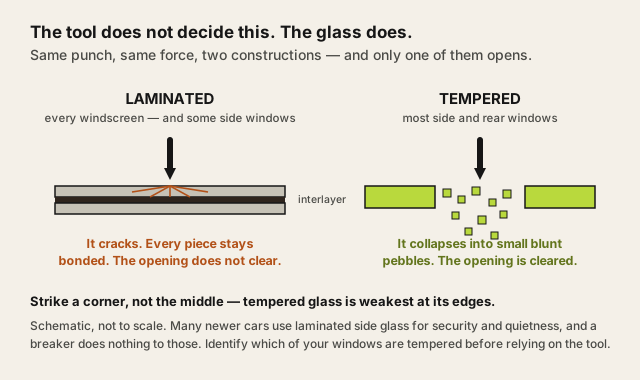
Windshields are laminated glass: two layers bonded to a plastic interlayer. They flex under impact rather than shattering, which is the property that stops occupants being thrown through them in a crash — and the same property that makes them impossible to punch out. A window breaker will crack a windshield and not clear it.
What a breaker does work on is tempered glass, used for most side and rear windows. Tempered glass is heat-treated to shatter into small, blunt pebbles under a sharp point, which is exactly what you want to clear an opening.
How to actually find out, in about a minute
This is free, and it is the step that makes everything above usable.
Every pane of automotive glass carries an etched legend, usually in a bottom corner, listing the manufacturer and the glass type. The word you are looking for is "Tempered" (sometimes "Temperglass") or "Laminated". Check each side window individually rather than assuming they match — mixed configurations are common, with laminated fronts and tempered rears.
Do it in daylight with the door open, note which windows are tempered, and put the tool where it can reach one of them. A tool positioned next to a laminated window is decoration.
What the testing actually found
AAA tested six escape tools in 2019 — three spring-loaded and three hammer-style. Two results are worth carrying:
- On tempered glass, all three spring-loaded tools worked. Only one of the three hammer-style tools did. That is the evidence behind the recommendation below rather than a preference.
- On laminated glass, none of the six worked — the glass cracked and stayed in place.
AAA also noted that roughly one in three 2018 model-year vehicles had laminated side windows, and that share has not gone down since. This is not an edge case for exotic cars.
Why spring-loaded beats a hammer
The two mechanisms are not equivalent, and the difference matters precisely in the conditions you would use one.
A spring-loaded punch needs no swing room. You press it into a corner of the glass and it fires a hardened point with stored force. That means it works while pinned in a seat, one-handed, in a footwell with no space — and it works underwater, where a swing loses most of its force to water resistance.
A hammer type depends on your strength and room to move, both of which may be gone in the moment it is needed. It is the cheaper, more common design and the less reliable one.
Buy the spring-loaded mechanism, from a maker that states it plainly.
Break a corner, not the middle
Tempered glass is strongest in the centre of the pane and weakest at the edges and corners. A punch into a corner shatters the whole pane with far less force than a blow to the middle. Aim for a corner, turn your face away, and the pane goes at once.
This page contains affiliate links. If you buy through them, Ugly Fixes may earn a commission at no extra cost to you. Products are selected independently.
Seatbelt cutter and window breaker
A spring-loaded punch, not a hammer, and a recessed belt cutter. Buy on the mechanism — this is a use-once, life-or-death tool.
See current options(opens in a new tab, affiliate link)Affiliate link. Price shown on the merchant's site.
The half you are more likely to need
The seatbelt cutter is the less dramatic and more probable half. After an impact a belt can lock under load, or the buckle can deform or become trapped, and a recessed blade slices the webbing in a single pull without the risk to your hand that a knife carries. Statistically it is the part of the tool you are more likely to use, which is why the two are always sold together.
Placement is the whole point
Everything above is undone by keeping the tool somewhere you cannot reach it. In the situations it exists for — a crash, a submersion, a fire — you may be pinned, disoriented, injured or in rising water, and unable to move. So it lives:
- Attached near the seatbelt buckle, or
- Clipped to a vent or in the door pocket — within reach with the belt fastened.
Not in the glovebox, not under a seat, not in the boot. A tool you cannot reach is not a safety device; it is a paperweight that makes you feel prepared.
Where this fits
It is the genuinely-serious end of the roadside kit in roadside readiness for an older car, which orders the rest of what a car should carry by how likely each failure actually is. The documents you would want reachable in an incident belong with it, in a glovebox document holder.
Questions people actually ask
Will a window breaker break my windshield?
Does it work on all side windows?
Spring-loaded punch or hammer type?
Where should I break the window?
Where should the tool be kept?
What is the seatbelt cutter for?
Is a cheap one good enough?
Question this page did not answer? Ask it.