Daily Driver
Can a DIY Windshield Chip Kit Work?
The goal is stopping a chip becoming a crack, not making glass look new. Which damage qualifies, and the camera behind the mirror that changes the answer.
Contents
Windshield chip kits are easy to oversell because the before-and-after promise is so tempting. The honest goal is not invisible glass. It is preventing a small chip from becoming a crack that demands replacement.
That is a useful goal, but only for the right damage.
A note on this guide: this rests on how resin repair works and what it can and cannot fix, not on chips repaired here. See how we test.
What a chip actually is
A windshield is laminated: two layers of glass bonded to a plastic interlayer. That construction is why it does not shower you with fragments, and it is also why repair is possible at all.
A repairable chip is damage to the outer layer only, with the interlayer intact. The resin fills the void, bonds the fractured glass, and restores enough structural continuity that the damage stops propagating. If the inner layer is affected, none of that applies and no kit helps.
That is the whole basis for the size and position limits below — they are not arbitrary caution.
Which damage qualifies
- Bullseye
- Circular cone break — usually the most repairable
- Star break
- Short radiating legs — repairable if the legs are short and stable
- Combination break
- Bullseye with legs — repairable when small
- Long crack
- Not a DIY kit job
- Edge damage
- Replacement territory — highest stress area
- Driver's primary view
- Even a good repair leaves distortion; get advice first
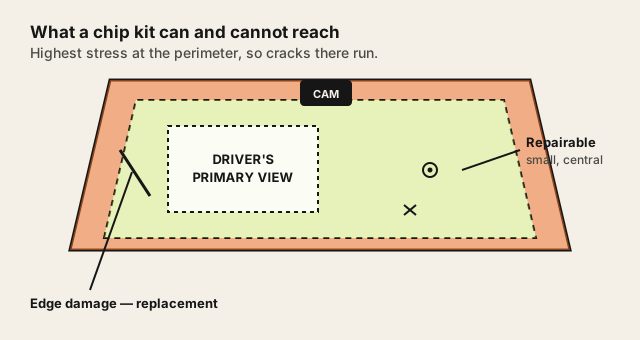
Two limits do most of the excluding. Size: roughly a small coin is the practical ceiling for a home kit. Position: away from the perimeter, because glass near the edge is under the most stress and cracks there run readily.
The third limit is the driver's sight line. A successful repair still leaves some optical distortion, and putting that directly in front of the driver is a poor trade even when the repair itself works.
This page contains affiliate links. If you buy through them, Ugly Fixes may earn a commission at no extra cost to you. Products are selected independently.
Rain-X windshield repair kit
Rain-X
For small chips only. Follow the kit instructions and avoid using it on spreading cracks.
Check price and availability(opens in a new tab, affiliate link)Affiliate link. Price shown on the merchant's site.
What to expect
Expect improvement, not disappearance. Resin can reduce the visible white fracture lines and help stabilize the chip, but damaged glass remains damaged glass.
Work cleanly, keep moisture out before repair, and do not wait weeks while the chip collects dirt. Dirt trapped in the damage is one reason repairs stay visible.
Conditions matter more than technique
Most kits use a resin cured by ultraviolet light, which puts real constraints on when to do this:
- The glass must be dry. Water in the chip blocks the resin, and a chip that has been rained on needs time — and warmth — to dry through before anything else happens.
- Not in direct sun. Sunlight starts curing the resin before it has drawn fully into the break, which is the most common reason a home repair sets badly. Work in shade, then let it cure in light.
- Not on hot or freezing glass. Both change how the resin flows, and extreme temperature is what propagates the damage in the first place.
You get one attempt, by the manufacturer's own guidance. Rain-X states it does not recommend applying the kit more than once to the same damage site. The resin is injected and cured once; a rushed first attempt leaves a chip that is partly filled, partly contaminated, and no longer a candidate for the product.
- Resin
- 1 g bottle
- Process
- A one-time injection and cure — Rain-X does not recommend applying the kit more than once to the same damage site
- In the kit
- Resin, repair device, curing strips, sleeved razor blade, instruction sheet
- Works best on
- Round damage no more than 1 in across, and cracks no longer than 12 in
- Will NOT repair
- Damage through more than one layer of glass
- Cure time and temperature
- Not published on Rain-X's web pages; they are on the printed instruction sheet
Two details worth noting from that list. The hard limit Rain-X states is structural, not dimensional — it will not repair damage through more than one layer of glass — and the size figures are published as "works best on" rather than as a rating. Cure time and working temperature are not on Rain-X's web pages at all; they are on the printed sheet in the box, which is a reason to read it before starting rather than during.
Protect it while you wait
The most useful thing you can do the moment a chip appears costs nothing: put a piece of clear tape over it.
That keeps out water and road dirt, both of which contaminate the break and prevent a clean repair later. It is the single highest-value action in this entire guide and it happens before any product is involved.
Then avoid the two things that turn chips into cracks: heavy flex — potholes, slammed doors — and thermal shock. Aiming a hot defroster at a frozen windshield with a fresh chip in it is a reliable way to watch a crack grow across the glass.
Where to go next
For the trim and chrome around the glass, which is easy to damage while working near it, see clean windshield molding without scratching chrome.
Heat cycling is part of what stresses glass, and a shade reduces it — see windshield sun shades and fit.
For what else belongs in the car against small failures, see the roadside kit for a car that might not start.
Questions people actually ask
Will a windshield repair kit make the chip invisible?
Which damage can actually be repaired?
Why does damage near the edge matter so much?
Does my car have a camera on the windshield?
How soon should a chip be repaired?
What makes a chip spread?
Question this page did not answer? Ask it.