Daily Driver
Accordion vs Twist-Fold Sun Shades
One packs smaller, one needs no technique. Which you will still be using in August, and why custom-fit beats both on the thing that actually matters.
Before you buy anythingThis page also considers a custom-fit shade, Parking in shade and Window tint on the side glass. Why, and when each is the better answer.
Contents
Windshield shades are sold on heat claims and abandoned over folding. The material barely varies between products; what varies is whether the thing goes back in its place without a fight, and that decides whether you own a sun shade or a silver rectangle in the rear footwell.
A note on this comparison: researched from construction, fit and deployment rather than measured temperature testing. See how we test.
The short version
Accordion if you want it to work without learning anything. Twist-fold if you already know you can collapse one and you want it to pack into a pouch. Custom-fit if you keep the car and want the coverage argument actually won.
| Accordion panel (our pick) | Twist-fold spring | Custom-fit | |
|---|---|---|---|
| Choose this if | You want nothing to learn | You have twist-folded one happily before | You want the A-pillar corners actually covered |
| Technique required | None | A specific wrist motion | None |
| Packed size | Flat and wide | Smallest, into a pouch | Flat, per-car |
| Where it stores | Behind a seat, boot | Door pocket, glovebox | Behind a seat |
| Coverage at A-pillar corners | Partial — square corners on a raked screen | Partial | Full, by definition |
| Deploys one-handed | Roughly | Yes once unrolled | Roughly |
| Holds position unaided | Yes, it is rigid | Yes, sprung against the glass | Yes |
| Fits more than one car | Yes | Yes | No |
| Cost | Low | Low | Highest |
| Abandoned because | Too bulky to store neatly | Refolding it is irritating | Rarely — it fits |
The highlight is the pragmatic pick rather than the best object. An accordion shade is not superior; it is the one most likely to still be in use next summer.
The folding question is the whole comparison
Everything else about these products is close to identical. They are reflective panels held against glass.
The accordion is a series of rigid panels hinged along their edges. It concertinas flat, slides behind a seat, and requires nothing of you beyond folding it the way it obviously wants to fold. Its cost is bulk: it does not disappear into a door pocket.
The twist-fold is a sprung wire loop in a fabric skin. It springs open instantly, which is delightful, and collapsing it means bringing your hands together in a particular way while twisting — unobvious until demonstrated. People who learn it prefer these permanently. People who do not perform the wrestle once in a hot car park and quietly stop bothering.
Buy for the version of yourself with shopping in one hand and a car that has been in full sun since nine. That is the condition that determines whether a shade earns its space or joins the collection described in car clutter.
Where fit beats folding
Both universal formats share a weakness, and it is the one that actually limits performance.
A raked windshield curves at the A-pillars. A rectangular shade meets it with square corners, leaving two triangular gaps sitting directly over the top of the dashboard — which is the surface you were protecting. The panel material is irrelevant to what happens through those gaps.
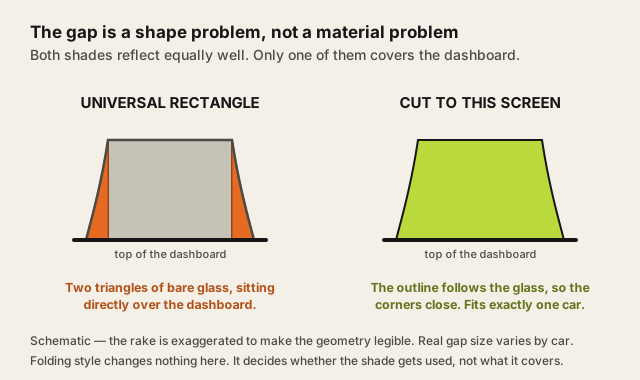
A custom-fit shade is cut to your specific screen and fills them. It costs more, it fits exactly one car, and it is the only version of this product where the coverage claim is straightforwardly true.
This page contains affiliate links. If you buy through them, Ugly Fixes may earn a commission at no extra cost to you. Products are selected independently.
Foldable windshield sun shade
Measure the screen at its widest and tallest, and pick the folding style you will still perform in August.
See current options(opens in a new tab, affiliate link)Affiliate link. Price shown on the merchant's site.
What the shade is actually doing
Not cooling the cabin much. The car remains a greenhouse — glass on every side is still admitting energy and the air inside still heats.
What changes decisively is the temperature of surfaces in direct sun: the wheel, the dash top, the gear selector, the seat bolsters. Those absorb radiation directly and are what is genuinely painful after an afternoon.
The longer-term benefit is the one nobody advertises: ultraviolet exposure fades and embrittles dash plastics, cracks vinyl and dries leather over years. On a car with a dashboard that is no longer available as a part, habitual shade use is among the cheapest preservation measures available. That argument is made in full in windshield sun shades are mostly about fit.
Where it sits among the small stuff
Alongside the other cabin items that have to earn permanent space — ugly daily-driver products that earn a place.
If this is not right for you
- A custom-fit shade
- Cut to your specific windshield, so it fills the A-pillar corners that defeat every universal shade. Costs more and only fits one car.
- Parking in shade
- Free, more effective than any shade, and available more often than people act on once they start looking for it deliberately.
- Window tint on the side glass
- Addresses the load a windshield shade cannot touch, permanently and without deployment effort — subject to local legality on front side windows.
Questions people actually ask
Which type should I buy?
Why do people abandon twist-fold shades?
Is a custom-fit shade worth the extra?
Do they actually cool the cabin?
Will either interfere with a dashcam or sensors?
What about the side and rear windows?
Question this page did not answer? Ask it.