Storage & Organization
Pegboard vs Cabinets in a Small Garage
Visible and reachable, or protected and tidy. In a garage with a car in it, the decision is made by depth and door swing — not by preference.
Before you buy anythingThis page also considers a rolling tool cart, Open shelving and French cleat rail. Why, and when each is the better answer.
Contents
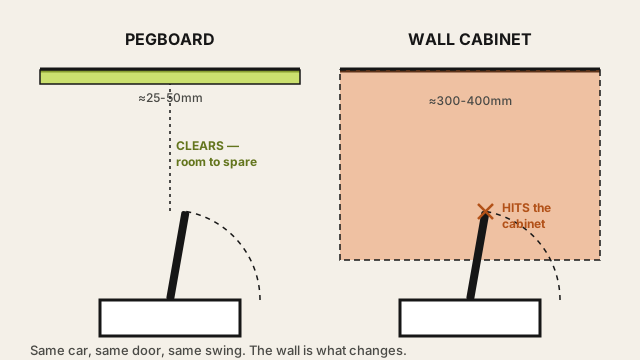
The pegboard-versus-cabinet argument is usually had on aesthetic grounds. In a one-car garage it is settled on geometry, and the deciding number is how much depth you have before a car door hits something.
A note on this comparison: researched from geometry, materials and known failure modes rather than long-term use. See how we test.
Measure before deciding anything
Park the car as you actually park it — not centred, not with the mirrors folded — and open the driver door fully. Measure from the wall to the door edge.
If that number is under roughly 300 mm (about 12 in), cabinets are out on that wall regardless of what you would prefer, and the decision has been made for you.
Why 300 mm is the threshold
Wall cabinets commonly sit between 300 and 400 mm deep before the door is considered. Pegboard and its standoff account for roughly 25 to 50 mm, plus whatever the tool projects.
So the two options are not competing for the same space by a small margin. A cabinet wall and a pegboard wall differ by something like a quarter of a metre, which in a single-car garage is often the difference between opening the car door and not.
Measure at door-handle height as well as at the widest point. Doors on older cars are frequently longer than modern ones and swing further before they clear.
| Pegboard | Wall cabinets | |
|---|---|---|
| Choose this if | Under ~300 mm from wall to open door | Over ~300 mm, measured with the car parked as you park it |
| Typical depth used | Roughly 25-50 mm plus tool depth | Roughly 300-400 mm plus door swing |
| Finding a tool | Visible at a glance | Behind a door, out of sight |
| Putting a tool back | One movement, no door | Open, place, close |
| Dust and damp | Everything exposed | Contents protected |
| Security | None | Lockable |
| Looks tidy when full | Only if you keep it disciplined | Yes, by hiding everything |
| Suits boxed or bulky items | Poorly | Well |
| Reconfigurable | Instantly | Not really |
| Cost per usable wall | Lower | Higher |
| Needs fixing into structure | Yes, ideally onto a batten | Yes, and more critically |
| Failure mode | Hardboard pegs work loose over time | Fixings pull out if badly mounted |
No highlight on this table, deliberately. Neither wins in general — the answer is determined by your depth and by which of the two problems you actually have.
What each is genuinely good at
Pegboard is good at frequently used tools. The reason is not storage density; it is that putting something back takes one movement and no door. Tools stored behind a door get put down instead of put back, and that is the whole mechanism by which a garage becomes untidy.
Cabinets are good at everything else. Consumables, boxed items, chemicals, things you use twice a year, and anything that should not be coated in dust. They are also the only option if security matters.
The practical answer for most small garages is both, in the right proportion: pegboard immediately around the bench, a cabinet for everything that does not earn bench-adjacent space.
The proportion that usually works
A useful rule is that bench-adjacent wall should hold only what you touch in a typical session — which for most people is a surprisingly short list. Everything else can be a door away without costing anything, because you were going to walk to it regardless.
People get this backwards and fill their best wall with the things they use least, then wonder why the bench is permanently covered.
This page contains affiliate links. If you buy through them, Ugly Fixes may earn a commission at no extra cost to you. Products are selected independently.
Wall Control metal pegboard tool organizer
Wall Control
Metal rather than hardboard, for the reason described below.
Check price and availability(opens in a new tab, affiliate link)Affiliate link. Price shown on the merchant's site.
Mounting is where both options fail
The comparison above assumes both are fitted properly, and in practice that assumption is where most of the disappointment comes from.
Neither option can be fixed to bare plasterboard and asked to hold weight. Both want studs or masonry, and the pegboard problem specifically is that its fixing holes rarely align with where the studs are. Fitting horizontal battens across the studs first, then mounting the panel to the battens, resolves that and has the useful side effect of creating the standoff the pegs need anyway.
A cabinet mounted into plasterboard alone does not fail gradually. It fails at once, with the contents inside it.
The mistake both options share
Neither works if you cannot see. A garage dim enough that you are guessing at what is on the wall will not stay organised regardless of what you fit, because sorting things in poor light is unpleasant enough that people stop doing it.
If the garage is dark, deal with that first — see garage lighting for a low ceiling and the Barrina LED shop light review for the cheapest way to fix it without new wiring.
The wider strategy for a garage with a car permanently in it is in how to organize tools in a one-car garage. For the sockets specifically, which suit neither a pegboard hook nor a cabinet shelf especially well, see magnetic socket organizers.
If this is not right for you
- A rolling tool cart
- Fixes nothing to the wall, parks in front of the car when the car is out, and comes with you when you move. The right answer for renters and for very narrow garages.
- Open shelving
- Cheaper than cabinets and more flexible than pegboard for boxed items, at the cost of depth and of everything visibly accumulating dust.
- French cleat rail
- More adaptable than pegboard for heavy or oddly shaped tools, and buildable from offcuts, at the cost of making each holder yourself.
Questions people actually ask
How much depth does a cabinet actually need?
How much depth does pegboard need?
Is metal pegboard worth it over hardboard?
Can I fit either to a plasterboard wall?
Which one keeps a garage tidy for longer?
What if the only free wall is behind the car?
Question this page did not answer? Ask it.