Storage & Organization
Pegboard vs French Cleat for a Garage Wall
One you buy and hang tools on; one you build and can hold anything. Which suits a small garage, and the depth difference that decides it.
Before you buy anythingThis page also considers Slatwall panel, a rolling tool cart and Open shelving. Why, and when each is the better answer.
Contents
Both put tools on a wall and that is where the similarity ends. Pegboard is a product you buy and hang things on. A French cleat is a system you build, where every holder is something you make.
In a small garage the decision usually comes down to what you own, how heavy it is, and whether you have a saw.
A note on this comparison: researched from geometry, load path and known failure modes rather than long-term use. See how we test.
How each one actually carries load
This is the difference everything else follows from.
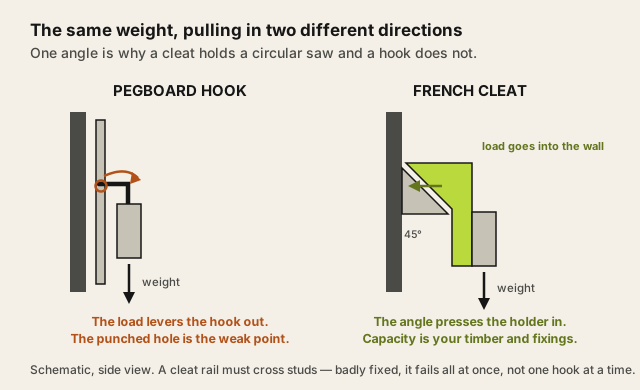
Pegboard transfers load through individual hooks sitting in punched holes. The hook is held by geometry and friction, the panel is held by its fixings, and the weakest point is the hole. That is fine for spanners and screwdrivers and it is the reason heavier items pull hooks out or elongate holes in hardboard.
A French cleat transfers load through a continuous bevelled rail screwed across several studs. The holder hooks over the rail at 45 degrees, so the tool's weight pulls the holder into the wall rather than away from it. Capacity is then a question of your timber and your fixings, not of a punched hole.
That single distinction explains why cleat systems carry cordless drill charging stations, circular saws and clamp racks, and pegboard generally does not.
| Pegboard | French cleat | |
|---|---|---|
| Choose this if | Hand tools, and you want it usable today | Heavy or awkward tools, and you will build holders |
| Load path | Individual hook in a punched hole | Continuous rail across studs |
| Heavy or awkward tools | Poor — hooks lift and holes elongate | Excellent, limited by your fixings |
| Typical depth used | Roughly 25-50 mm plus tool | Rail plus holder, usually a little more |
| Cost in money | Lower | Low materials, higher if buying timber |
| Cost in time | Fit the panel and you are done | Every holder is a small project |
| Tools needed to install | Drill | Drill, plus a saw that cuts a 45-degree bevel |
| Repositioning | Move a hook | Lift a holder off and rehang anywhere on the rail |
| Holds odd shapes | Only what a hook fits | Anything you can build a cradle for |
| Looks tidy | Immediately | Once you have made enough holders |
| Fails by | Hooks dropping tools | A badly fixed rail, which fails all at once |
No highlight. These suit different people, and the honest answer for many garages is both.
Steel moves the weak point rather than removing it
The hole-elongation failure above is a hardboard failure. A metal pegboard in 20 gauge steel does not elongate, and Wall Control's own figures for the board this site links to say so indirectly:
- Panels
- 3 panels, 32 in x 16 in each
- Coverage
- Over 10.5 sq ft of pegboard wall
- Included
- One 9 in and one 6 in shelf assembly, 3 plastic bins with hangers, a screwdriver holder, a hammer holder and 20 assorted hooks and brackets
- Material
- 20 gauge steel
- Warranty
- Limited lifetime warranty against product failure and manufacturing defects
- Load guidance
- Wall Control recommends up to 100 lb per panel into drywall and 200 lb into studs — stated as a recommendation, not a rated capacity
- Fixing pattern
- Patented slot and hole design; accepts Wall Control slotted accessories and conventional 1/4 in pegboard hooks
- Installed size
- 48 in x 32 in
- Mounting hardware
- Screws and drywall anchors included
Read the load line carefully, because the wording is the manufacturer's and it matters: 100 lb per panel into drywall and 200 lb into studs are given as a recommendation, not a rated capacity — and Wall Control publishes no per-hook load rating at all.
So steel fixes the panel and leaves the hook unquantified. A cleat's capacity is a question you can answer with your timber and your fixings; a metal pegboard's capacity is a number nobody has published for the part that actually lets go. That is not an argument against it — it is the reason the comparison above still lands the same way for heavy tools even when the board is steel.
Where pegboard is the right call
- You want it working this weekend. Fit the panel, hang the hooks, done. A cleat system is functional immediately and only becomes good after you have made a dozen holders.
- Your tools are mostly hand tools. Spanners, screwdrivers, pliers and files are exactly what pegboard was designed for.
- You do not own a saw that cuts a bevel. This is the genuine gate. Without a table saw or a guided circular saw, cutting accurate 45-degree rails is awkward enough to stall the project.
- Depth is critical. Pegboard is marginally shallower, and in a garage where a car door swings past the wall, marginal counts.
Use metal rather than hardboard for the reason covered in pegboard vs cabinets in a small garage: hardboard pegs work loose, holes elongate, and the board swells in a damp garage.
This page contains affiliate links. If you buy through them, Ugly Fixes may earn a commission at no extra cost to you. Products are selected independently.
Wall Control metal pegboard tool organizer
Wall Control
Metal rather than hardboard. The failure mode of hardboard is slow and ends with tools on the floor.
Check price and availability(opens in a new tab, affiliate link)Affiliate link. Price shown on the merchant's site.
Where the cleat is worth the effort
- Heavy, odd or valuable tools. Anything a hook cannot hold, or anything you would rather not have drop.
- A layout you expect to change. Holders lift off and rehang anywhere along the rail with no tools and no new holes. Pegboard is adjustable within its grid; a cleat is adjustable without one.
- You enjoy making things. Every holder is a small offcut project. For some people that is the appeal and for others it is the reason it never gets finished, and it is worth being honest with yourself about which you are.
The combination worth considering
Fit a cleat rail across the studs. Hang a pegboard panel on the cleat.
You get the cleat's load path and repositionability for the heavy items, pegboard's convenience for hand tools, and a pegboard panel that can now be moved — which it could not be if screwed directly to the wall. The battens a pegboard wants for standoff and stud alignment are most of a cleat rail already, so the extra work is the bevel and little else.
Neither works in the dark
A wall you cannot see is a wall that stops being used, whatever is fixed to it. If the garage is dim, that is the first purchase rather than the second — see garage lighting for a low ceiling.
The wider strategy for a garage with a car permanently in it is in how to organize tools in a one-car garage, and the sockets, which suit neither system especially well, are covered in magnetic socket organizers.
If this is not right for you
- Slatwall panel
- Commercial middle ground with bought accessories and adjustable positioning, at a cost per metre that makes it hard to justify for a domestic single-car garage.
- A rolling tool cart
- Fixes nothing to the wall, comes with you when you move, and parks in front of the car when the car is out — the right answer for renters and very narrow garages.
- Open shelving
- Cheaper than either for boxed items and consumables, at the cost of depth and of everything visibly collecting dust.
Questions people actually ask
Which holds heavier tools?
Which uses less depth?
Do I need woodworking tools for a French cleat?
Can I mix the two?
Why do pegboard hooks keep falling out?
Which is cheaper?
Question this page did not answer? Ask it.