Battery & Electrical
Replacing a Corroded Earth Strap
A bad return path imitates a dozen other faults, and every one of them costs more to replace. How to test the ground before you suspect anything expensive.
Contents
Test the ground before suspecting anything expensive. A corroded earth strap produces symptoms that look like a starter, an alternator, a battery or a sensor — and it is the cheapest part in that list by a very long way.
The test that finds it is a voltage drop under load, not a resistance reading.
A note on this guide: this rests on how return paths and voltage drop behave, not on faults diagnosed here. See how we test.
The problem, as it appears
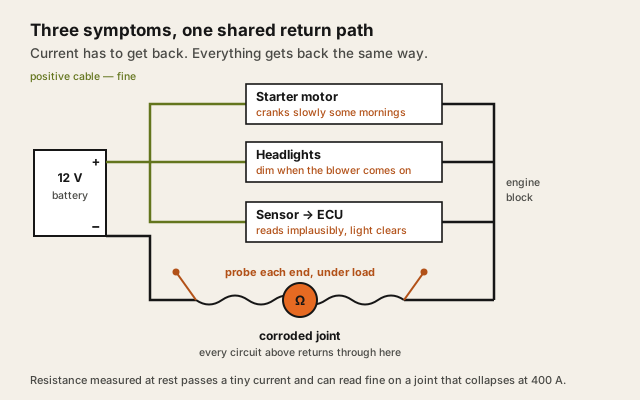
Something electrical is wrong and the symptoms do not agree with each other. The engine cranks slowly some mornings. The headlights dim when the blower comes on. A warning light appears and clears. A sensor reads implausibly.
Each of those has an obvious suspect, and the suspects are all different. That disagreement is itself the clue.
Why chasing each symptom disappoints
Because they can share one cause, and it is not on anyone's list.
Current has to get back to the battery. It leaves through the positive cable, does its work, and returns through the engine, body and the straps bonding them together. That return path is expected to have almost no resistance.
When it does have resistance, every circuit using it loses some voltage — and each circuit expresses that loss in its own way. So you get a starter symptom, a lighting symptom and a sensor symptom from one corroded connection, and replacing any single component fixes none of them.
What actually matters
Voltage drop under load, not resistance at rest
This is the technique, and it is the reason most people miss this fault.
A multimeter measuring resistance pushes a very small current through the joint. A corroded connection can pass that happily and still collapse when a starter asks for hundreds of amps — so the meter reads fine and the fault is cleared from the list.
Instead, measure the drop across the strap while it is working. One probe at each end, meter set to DC volts, and load the circuit — cranking is the usual way. A healthy strap shows only a small drop. A significant one means resistance where there should be virtually none.
This page contains affiliate links. If you buy through them, Ugly Fixes may earn a commission at no extra cost to you. Products are selected independently.
Automotive multimeter
The drop test is what finds this. Resistance at rest is the reading that misses it.
See current options(opens in a new tab, affiliate link)Affiliate link. Price shown on the merchant's site.
The same instrument does the other high-value battery test, in the parasitic drain test.
Test every strap, not just the obvious one
There is usually more than one. Battery to body, body to engine, and frequently a smaller strap to the gearbox or a bonding point for the exhaust or steering column.
A weak one anywhere in that chain affects whatever depends on it. Working through them with the drop test is faster than guessing which one matters.
Clean and re-test before replacing
A good proportion of these are surface corrosion at the bolted ends rather than a failed strap.
Undo it, clean both mating faces and the strap eyelets back to bright metal, reassemble properly and re-test. If the drop has gone, you are finished and it cost nothing.
Battery terminal cleaning brush
Both mating faces, not just the visible one. Paint, rust and residue under a bolted joint are the resistance.
See current options(opens in a new tab, affiliate link)Affiliate link. Price shown on the merchant's site.
When the strap itself is finished
Replace it when the braid is green through its length rather than just at the ends, when strands have broken, or when the drop is still high after a proper clean.
Corrosion wicks along inside a braid and cannot be cleaned out. That is the same failure mechanism as moisture travelling along copper in a damaged wire, covered in repairing a broken car wire properly.
Battery earth strap
Match gauge and length to what came off. An undersized strap is a new resistance problem; a short one loads its mounts as the engine moves.
See current options(opens in a new tab, affiliate link)Affiliate link. Price shown on the merchant's site.
Protect the joint afterwards
A clean bolted connection in an engine bay starts corroding again immediately, and the protection is cheap.
Battery terminal protector spray
Applied after the joint is made and tight, not before. It protects a good connection rather than improving a poor one.
See current options(opens in a new tab, affiliate link)Affiliate link. Price shown on the merchant's site.
Where grease rather than spray belongs is set out in dielectric grease on corroded connectors.
The mistake to avoid
Clearing the ground with a resistance check. It is the intuitive measurement, it takes ten seconds, and it will tell you a failing joint is fine — because the meter's test current is nothing like what the circuit actually draws. Almost every expensive misdiagnosis in this area passes through that step.
The second mistake is replacing the battery first. It is the most accessible part, the symptoms fit, and a new battery in a car with a bad return path produces a brief improvement followed by the same fault — which then gets attributed to the new battery being faulty. Test the ground first; it is free and it is upstream of everything else, which is the same ordering battery terminal cleaning argues for.
Questions people actually ask
What does an earth strap actually do?
Why does it imitate other faults?
How do I test it properly?
Why is a resistance check not enough?
Is cleaning enough, or does it need replacing?
Does the replacement have to match?
Question this page did not answer? Ask it.