Diagnostics
Using a Multimeter to Find a Parasitic Drain
The measurement three other pages on this site tell you to take. How to take it without blowing the meter fuse, and how to isolate the circuit responsible.
Contents
Three other pages on this site tell you to measure the parasitic draw before buying anything. This is the page that explains how, because the measurement is genuinely simple and the two ways to get it wrong are both avoidable.
A parasitic draw is what the car consumes with the key out: clock, radio memory, ECU keep-alive, alarm, tracker, and forty years of accumulated additions on an older car. It is the reason a healthy battery is flat in March.
A note on this guide: this rests on the standard method and what the readings mean, not on drains measured here. See how we test.
Before you touch anything
Know your radio and security codes. You are about to disconnect a battery terminal. On some cars that is nothing; on others it is an afternoon of re-entering settings.
Let the car sleep. This is the step people skip and it invalidates everything downstream. Modules stay awake after locking — often for many minutes — and a reading taken straight away measures the car going to bed rather than the car asleep. Lock it, walk away, come back and watch the figure fall until it settles.
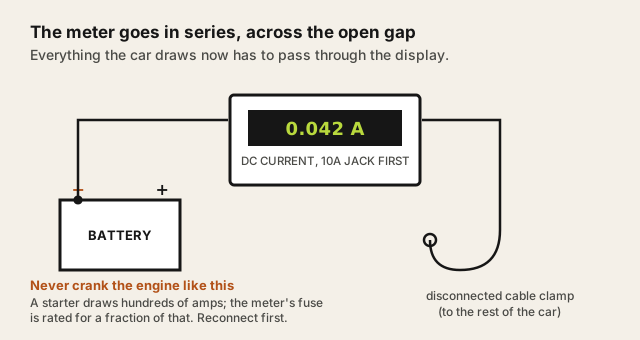
Understand what the meter becomes. In current mode a multimeter is not an observer. It is a wire in the circuit, carrying everything the circuit draws, protected by a small internal fuse.
Taking the reading
- Disconnect the negative terminal. Negative first, always — with the earth removed, a spanner touching bodywork cannot complete a circuit.
- Set the meter to DC current, using the highest current range first. Most meters have a separate 10A jack for this and a lower milliamp jack; start in the 10A jack.
- Put the meter in series — one probe on the battery negative post, the other on the disconnected cable clamp. Everything the car draws now flows through the meter.
- Wait. Watch the reading fall as modules time out. Minutes, not seconds.
- Once settled and clearly below an amp, move to the milliamp jack for resolution. Moving down a range while the car is still awake is how fuses die.
- Read the resting draw.
Reading the result
There is no universal correct number, which is why the comparison that matters is against what your own car should plausibly pull.
A figure in the tens of milliamps is unremarkable on anything with electronics. A figure in the hundreds means something is not going to sleep. On a genuinely simple classic — no alarm, no ECU, no memory — the honest expectation is very close to nothing, and tens of milliamps there is already a question.
Isolating the circuit
Once you know there is a draw, finding it is tedious and mechanical rather than clever:
- Leave the meter connected and reading.
- Pull one fuse at a time, watching the display.
- When the reading drops to what it should be, the circuit you just interrupted contains the culprit.
- Put each fuse back before pulling the next, or you will end up with several circuits open and no idea which mattered.
Two cautions. Pulling a fuse can wake a module, so allow the reading to settle again after each. And the fuse box is not the whole car — anything wired directly to the battery by a previous owner bypasses it entirely, which on an older car is a very live possibility.
The other measurement worth knowing
Resistance testing a suspect connection with the circuit dead is the intuitive approach and it is frequently useless. A corroded joint can measure acceptably at rest and collapse the moment real current passes through it.
Voltage drop measures the loss across a connection while it is working. Put the meter in DC volts, probe each side of the joint, and load the circuit. A healthy connection loses very little; a bad one shows the loss immediately, under exactly the conditions that matter.
This is the right test for the classic slow-cranking symptom — everything electrical works, the dashboard stays bright, the starter turns slowly. That pattern is usually resistance in a joint, and the battery terminal brush guide covers the cheapest place to start looking.
What meter to buy for this
Two features decide it and neither is accuracy:
- Fused current inputs. Non-negotiable. The mistake described above will happen eventually, and the fuse is the difference between replacing a fuse and replacing a meter.
- A milliamp range. You are hunting tens of milliamps. A meter that only resolves to a tenth of an amp cannot see the thing you are looking for.
A DC clamp meter is the comfortable upgrade: it reads current through the insulation with nothing disconnected, so there is no fuse to blow and no codes to lose. Check its lowest DC range before buying, because plenty of affordable clamp meters cannot resolve milliamps and are therefore useless for precisely this job.
This page contains affiliate links. If you buy through them, Ugly Fixes may earn a commission at no extra cost to you. Products are selected independently.
Automotive multimeter
For this job it needs fused current inputs and a milliamp range — accuracy to a fourth decimal place is irrelevant.
See current options(opens in a new tab, affiliate link)Affiliate link. Price shown on the merchant's site.
Where a page is choosing the tool rather than using it, the generic record stops being enough — so here is the named one, and the reason it is named.
Klein Tools MM400 auto-ranging multimeter
Klein Tools
The 10 A jack is fused at 10 A / 600 V, which is the specification that matters here — this test puts the meter in series with the whole car. Named because that figure is published; a generic multimeter recommendation cannot carry it.
Check price and availability(opens in a new tab, affiliate link)Affiliate link. Price shown on the merchant's site.
The wider set of things a meter is worth owning for — battery state, charging voltage, a blown fuse, a dead bulb, a bad earth — is in a multimeter for car owners, not electricians. This page is the one check with real technique; that one is everything else.
When the answer is not a drain
Worth saying, because the measurement sometimes exonerates the car.
If the resting draw is normal and the battery still goes flat, the battery is the fault rather than the load on it. Resting voltage and the state-of-charge table in preventing a dead battery in winter storage is the next place to look, and a maintainer is the answer for a car that simply sits — covered in best battery maintainers for classic cars.
If you would rather watch the decline than measure it once, a Bluetooth battery monitor turns "the battery keeps dying" into a dated record — though it reports the symptom and never identifies the circuit, which is what brings you back to this page.
On a car new enough to have a port, some modules can be interrogated directly rather than deduced — see OBD2 scanners for normal owners, noting that a permanently plugged-in adapter is itself one more small parasitic load.
Questions people actually ask
What is a normal parasitic draw?
Why did my meter read high and then fall?
Why did I blow the fuse in my multimeter?
Can I measure the draw without breaking the circuit?
What is a voltage drop test and when is it better?
Do I need an expensive meter?
Question this page did not answer? Ask it.