Classic Car
Tires on a Car That Barely Moves: Age Beats Tread
A tire that rarely rolls stops replenishing its own ozone protection, so it ages out years before the tread wears down — and the date code says when.
Contents
A car that covers a few hundred miles a year wears its tires so slowly that tread depth stops being a useful measure of anything. The thing that will actually retire them is not visible in the tread at all.
A note on this guide: this rests on how rubber ages and deforms while stationary, not on tyres watched here. See how we test.
Why the tread-depth check misleads on this car specifically
The standard check — the 2/32-inch minimum, the penny test — measures wear from rolling. A car that barely rolls barely wears its tires. On a classic or a second car doing a few hundred miles a year, the tread can still be most of the way to new at the point the rubber itself is finished. Tread depth answers "have these been used up?" on a car where the answer is always no, and never gets round to asking the question that actually decides it.
What is happening to a tire that sits
Tire sidewall compounds carry antiozonants and waxes blended in specifically to protect the rubber from ozone and UV. They only do that job at the surface, and they get to the surface by flexing: as the tire rolls and deforms, those protectants migrate outward and replenish a layer that ozone is continuously consuming. The faint brown bloom on the sidewalls of a well-used car is that process visibly working.
A tire that does not flex does not replenish that layer. Once the surface protection is used up it is not replaced, and ozone attacks the rubber directly — which is why a garaged car with almost no miles on it can develop sidewall cracking that a daily driver on the same tires does not. Being parked out of the weather does not help much here, because the mechanism is not weather.
What actually matters
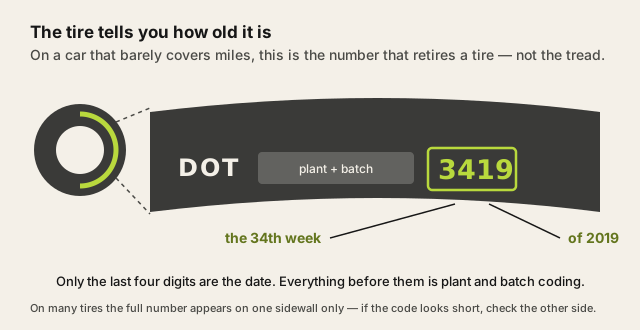
The date code, not the tread. Every tire's DOT identification number ends in four digits giving the
week and year of manufacture. 3419 is the 34th week of 2019. It is moulded into the sidewall, and on
many tires the full number appears on one side only, so check both before deciding it isn't there.
Vehicle and tire manufacturers commonly recommend having tires inspected from around six years old and replaced at around ten years from manufacture regardless of remaining tread. There is no US federal law imposing that — it is manufacturer guidance rather than a legal limit, which is worth knowing so you can weigh it against the condition in front of you rather than treat it as a deadline.
Check the date code on tires you are buying, too. A tire bought this year was not necessarily made this year, and stock can sit in a warehouse for a long time. On a car that barely accumulates mileage this matters more than it does on a daily driver: age, not wear, is what will end these tires, so buying ones that have already spent two years on a shelf spends a fifth of their calendar life before they have turned a wheel.
Pressure, while it is parked. Tires lose pressure slowly through the rubber itself, and a car that isn't driven never gets the incidental top-up a daily driver picks up at a gas station. An underinflated tire flexes and folds its sidewall under the car's static weight in exactly the area that is already most vulnerable to ozone cracking, so months of standing on soft tires ages them fastest at their weakest point.
This page contains affiliate links. If you buy through them, Ugly Fixes may earn a commission at no extra cost to you. Products are selected independently.
AstroAI digital tire pressure gauge
AstroAI
The point is checking often on a car that is not being driven — pressure falls whether or not it moves.
Check price and availability(opens in a new tab, affiliate link)Affiliate link. Price shown on the merchant's site.
Being able to add air at home. A car that barely moves is exactly the car for which "drive to the station and use the pump" is least practical — a trip made specifically to put air in is more driving than it does in a typical month, and it means driving there on the soft tires in the first place.
AstroAI cordless tire inflator
AstroAI
For a car that sits, topping up where it is parked is the difference between doing it and meaning to.
See current options(opens in a new tab, affiliate link)Affiliate link. Price shown on the merchant's site.
Flat spots, and moving the car
A car standing in one position for weeks develops a flat spot where the tread rests on the ground, most noticeably in cold weather. Usually it works itself out within a few miles as the tire warms and returns to shape; over a long enough storage period without the car moving at all, it can set permanently.
Moving the car far enough to put a different part of each tire on the ground every few weeks deals with that — and does more than that, because it is also the flexing the sidewall compound needs to keep renewing its own protection. It is the same small habit answering both problems, which is a good reason to make it the routine rather than an occasional intention.
The mistake to avoid
Reading tread depth as the tire's condition on a car that does not do the mileage to wear it down. The tread will very likely still be legal on the day the rubber stops being worth trusting. Check the date code first, look at the sidewalls rather than the tread for fine cracking, and treat plenty of remaining tread as what it actually is — a fact about mileage, not a statement about age.
This belongs with the rest of what a rarely driven car needs: the winter storage routine covers how the tires fit alongside the battery and the fuel, and covering it without trapping moisture deals with the paint side of the same standing-still problem. For the tools themselves, digital gauges versus the station pump and what actually matters in a portable inflator go further than this guide does.
Questions people actually ask
Where is the date code on a tire?
Do I have to replace tires at a certain age?
Does keeping the car in a garage stop tires ageing?
Is a flat spot from standing permanent?
Does the spare age too?
Question this page did not answer? Ask it.