Road Trip
Do Digital Tire Gauges Beat Gas-Station Pumps?
The advantage is not the display. It is checking cold, at home, with the same gauge every time — plus the sidewall number you should never inflate to.
Contents
The best thing about a handheld tire gauge is not that it is digital. It is that it lets you check pressures at home, before driving heats the tires and turns the number into a moving target.
A gas-station pump may be accurate. It may also have been dropped, frozen, driven over or left out in weather for years. The problem is that you do not know which.
A note on this guide: this rests on published accuracy figures and on why forecourt gauges drift, not on gauges compared here. See how we test.
What the handheld gauge is good for
Consistency. Even if a gauge is slightly off, the same gauge used the same way lets you notice a slow leak before it becomes obvious from the driver's seat.
Cold readings. Vehicle placard pressures are normally cold pressures. Checking after the trip to the station means you are already measuring a warmed tire.
Final setting after inflation. Built-in inflator gauges are often jumpy while the pump is running. Stop the pump, wait a moment, then use the handheld gauge for the final number.
The number you should not inflate to
Worth stating on its own, because it is the mistake with the largest consequences.
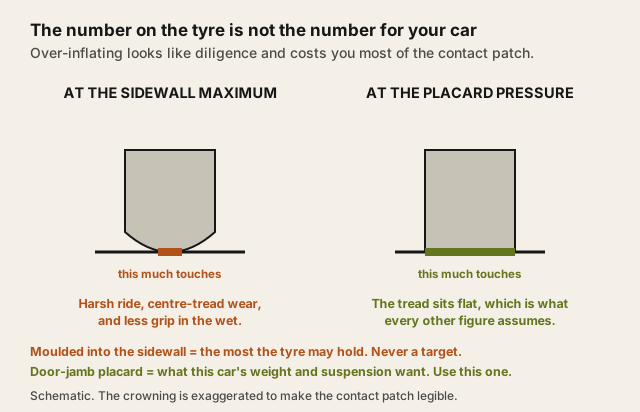
The pressure moulded into the tire sidewall is the maximum the tire is rated for. It is not a recommendation, and it is not what your car wants. The correct figure comes from the vehicle placard — normally a sticker in the driver's door jamb, sometimes in the glovebox or fuel filler flap — because correct pressure is a property of the car's weight and suspension, not of the tire alone.
Inflating to the sidewall maximum gives a harsh ride, a smaller contact patch, accelerated centre-tread wear and reduced grip in the wet. It is a very common error and it looks like diligence.
Cold, hot, and the thing the seasons do
"Cold" is not about the weather. A cold tire is one parked for at least three hours or driven under about a mile gently. A tire that has just covered twenty miles is a hot tire even on a freezing morning.
Two effects run at once and they are frequently confused:
- Driving heats tires, raising pressure by several PSI over a journey. This is normal, designed for, and the reason you never bleed a hot tire down to the placard figure — do that and it will be substantially underinflated once cool.
- Ambient temperature shifts pressure by roughly 1 PSI per 10 degrees Fahrenheit. A set correctly inflated in warm weather reads genuinely low after the first cold snap, with nothing leaking at all. This is why warning lights cluster on the first cold morning of autumn.
Checking cold, at home, with one gauge removes both confusions at once. That is the actual argument for owning one — not decimal places.
The accuracy claim you can actually check
Most gauges advertise accuracy with a number nobody can verify. There is a printed standard that means something: ANSI B40.1 (and B40.7 for the wider-range instruments), which grades a gauge by the tolerance it holds across its rated range.
| Grade | Tolerance |
|---|---|
| B | ±2% |
| A | ±1% |
| 2A | ±0.5% |
A gauge stating a grade has been tested to hold that tolerance. A gauge stating "high precision" with no grade has told you nothing checkable.
Two caveats worth keeping in proportion. First, on a tire inflated to around 32 PSI, even Grade B is well under a PSI of error — which is far smaller than the swing you get from checking warm instead of cold. The grade is a reason to prefer one gauge over another; it is not a reason to distrust a reasonable gauge you already own. Second, the rated range matters alongside the grade: a gauge graded across 3–200 PSI is doing something harder than one graded across 10–75, and for car tires the narrower range is entirely sufficient.
So: prefer a stated grade over an unverifiable adjective, and do not pay for 2A to check a family hatchback.
Held to its own standard, the gauge recommended below half-passes this test, and it is worth showing rather than glossing. AstroAI states "Calibrated to ANSI B40.7 ±1PSI" — which cites the standard, but gives a tolerance in PSI rather than one of the grades above, and states it only in the product title on its UK store. The US product page for the same gauge states no standard and no tolerance at all.
- Range
- 0-150 PSI
- Battery
- Lithium coin cells, included — AstroAI’s own page calls them “Lithium Metal” in the specifications and “Lithium Coin” in its comparison table
- Display
- Backlit LCD
- Auto shut-off
- 30-40 seconds
- Valve fittings
- Schrader, with a Presta adapter included
- Stated accuracy
- Calibrated to ANSI B40.7, ±1 PSI — stated in AstroAI’s UK product title only, not repeated in any body copy and absent from the US page
- Reading increment
- 0.1 PSI
That is better than "high precision" and weaker than a printed grade, which is exactly where most of this category sits. It is recorded that way in the specification above so the claim carries its own provenance, because a tolerance quoted from a marketing title is not the same kind of fact as a grade stamped on an instrument.
This page contains affiliate links. If you buy through them, Ugly Fixes may earn a commission at no extra cost to you. Products are selected independently.
AstroAI digital tire pressure gauge
AstroAI
Look for a stated ANSI grade rather than a marketing accuracy claim. Researched, not tested against a calibrated reference.
Check price and availability(opens in a new tab, affiliate link)Affiliate link. Price shown on the merchant's site.
What to look for
- A head that seals without needing three hands.
- A display you can read in the dark.
- A shape that fits your wheels, especially deep alloys or awkward valve stems.
- A simple reset button, because accidental retained readings are more common than people admit.
- Auto-off that is not too aggressive, since a gauge that blanks while you are reaching for the next wheel is a gauge you will use twice.
Digital, dial or pencil
All three can be accurate and all three can be poor. Digital is easiest to read and depends on a battery that will be flat when you need it in two years. A quality dial gauge is robust and readable without power. Pencil gauges are cheap, compact and the hardest to read precisely.
The choice matters far less than picking one and sticking with it, for the reason below.
The boring habit that matters
Pick one gauge and use it repeatedly. The trend is the useful part: one tire losing pressure faster than the others tells you more than a single heroic decimal place ever will.
That comparison only works if the readings come from the same instrument. A gauge with a consistent half-PSI error still identifies the tire that is going down; readings from three different forecourt pumps do not, however accurate any of them happens to be.
Check the spare while you are there. On an older car it is very frequently flat, and discovering that at the roadside is the least useful possible moment.
Where to go next
For the inflation side of the kit, see portable tire inflators: what actually matters, and for the corded-versus-cordless decision, 12 V compressor vs cordless inflator.
If a tire is losing pressure because something is in it, the limits of a roadside repair are covered in tire plug kits worth keeping.
Questions people actually ask
Are digital tire gauges more accurate than pump gauges?
Should tire pressure be checked hot or cold?
What counts as a cold tire?
Should I inflate to the number on the tire sidewall?
How much does temperature change tire pressure?
Should I let air out of hot tires to reach the placard pressure?
Question this page did not answer? Ask it.