Daily Driver
Choosing Wiper Blades That Actually Stop the Streaking
Rubber degrades on a UV and ozone schedule regardless of how the blade looks, and a beam blade resists winter icing in a way a framed one cannot.
Contents
Streaking, juddering, or a windshield that stays smeared after every pass is treated as a glass-cleaning problem more often than it's treated as what it usually actually is: rubber that has already failed.
A note on this guide: this rests on how blade types are constructed and how they fail, not on blades run here over a season. See how we test.
The problem, as it appears
Wipers that judder, streak, or leave an arc of unwiped screen exactly where you look — usually noticed for the first time at night, in rain.
The replacement aisle then offers three constructions at four price points, with nothing explaining what separates them.
Why "it looks fine" is not a reliable check
Wiper rubber degrades from UV exposure and ozone in the air, a chemical breakdown that hardens and cracks the edge from the outside in. This runs on roughly a six-to-twelve-month clock regardless of how much the car has been driven, and it is frequently not visible at a glance — a blade that looks intact can already be past the point of sealing evenly against the glass. Judging replacement by appearance alone is why so many cars run streaky wipers for months before anyone thinks to actually replace them.
What actually matters
Replace on a schedule, not on appearance. Twelve months is a reasonable default in a moderate climate; harsher UV exposure or a car parked outside year-round shortens that. Waiting for visible cracking or an obvious skip means driving with degraded rubber for however long it takes to notice.
This page contains affiliate links. If you buy through them, Ugly Fixes may earn a commission at no extra cost to you. Products are selected independently.
Windshield wiper blades
Check the correct length for both driver and passenger sides separately — they are often different, and buying one size for both is a common mistake.
See current options(opens in a new tab, affiliate link)Affiliate link. Price shown on the merchant's site.
Get both lengths right. Many cars specify a shorter blade for the passenger side than the driver side. Fitting two of the same length either leaves part of the passenger side unswept or has the oversized blade catching on trim — check both before buying, not just one.
Consider a beam-style blade for winter. A conventional framed blade has several metal pivot joints that ice and snow can pack into, eventually locking the frame and causing the whole blade to skip or judder. A beam-style blade's solid rubber spine has nowhere for that ice to accumulate, which is the actual mechanical reason it holds up better in genuinely cold, snowy conditions rather than just being marketed that way.
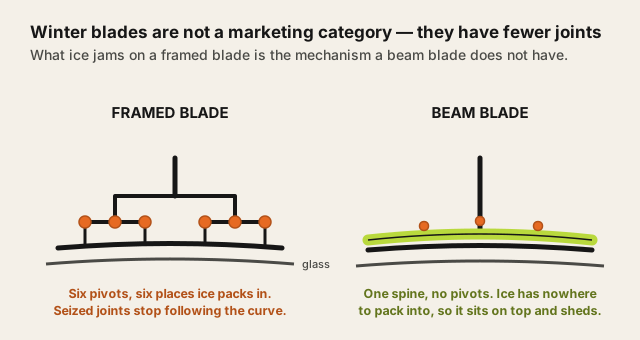
Those pivots are not incidental — they are how a framed blade works. The arm presses at one point and the yoke tree distributes that pressure along the blade so it can follow the curve of the screen. Ice in the joints does not simply add weight; it stops the tree articulating, so the blade goes rigid and can no longer sit flat against a curved windshield. A beam blade gets its pressure distribution from a pre-curved spine instead, which has no joints to seize in the first place.
The mistake to avoid
Treating streaking as a glass problem and reaching for another cleaner or a rain-repellent coating before checking the blades themselves. A rain-repellent treatment genuinely improves visibility on top of good wipers — it does not fix bad ones, and applying it to compensate for degraded rubber just means a treated windshield that still streaks.
Wiper condition is also worth checking at the same time as the surrounding trim and whether a sun shade actually fits — all three tend to get addressed in the same pass around the glass.
Questions people actually ask
How often do wiper blades actually need replacing?
Are the driver and passenger blades the same size?
Why do some blades judder or skip in a straight line?
Do winter-specific blades actually do something different?
Question this page did not answer? Ask it.