Emergency & Roadside
Are Tire Plug Kits Worth Keeping in the Car?
A plug fixes a nail in the tread and nothing else. Where the repairable area ends, why the industry calls it temporary, and what to carry alongside it.
Contents
A tire plug kit is one of those products that sits between useful and misused. For a simple puncture in the tread of a tubeless tire, it can get a car mobile again. For sidewall damage, a torn tire or a slow mystery leak, it is the wrong tool.
That distinction is the page.
A note on this guide: this rests on what a plug repairs and where it is not a repair at all, not on tyres plugged here. See how we test.
The repairable area is smaller than people assume
A tire is not uniformly repairable, and the boundary is not a matter of opinion.
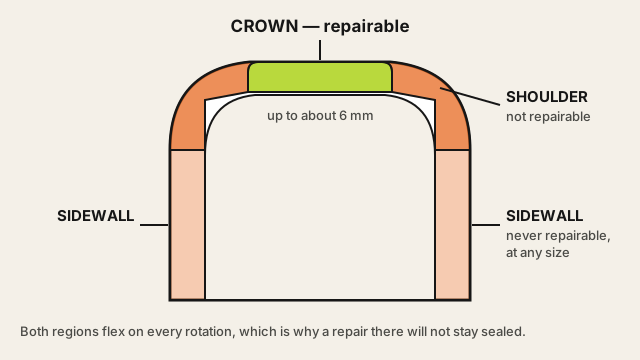
The crown — the tread across the centre of the tire — is the repairable zone. The shoulder, roughly the outer inch on each side where the tread curves down, is not. Neither is the sidewall, at all, ever.
The reason is flex. The sidewall and shoulder deform on every rotation and every steering input, and no plug or patch stays sealed in a region that is continuously working. A repair there fails, and it fails at the point when the tire is loaded hardest.
The second limit is size: roughly a quarter of an inch, or 6 mm. Past that, the belts and cords around the hole are damaged enough that sealing it is beside the point. A plug can make a large hole hold air without making the tire safe, which is precisely the failure mode this page exists to warn about.
Why the industry calls an external plug temporary
Not commercial caution — the objection is structural, and it is worth understanding rather than dismissing.
An external plug is installed without removing the tire from the wheel. That means:
- The inner liner is never sealed from inside, so air can still migrate between the belts even when the outer hole is plugged.
- Nobody has seen the inside. A tire run even briefly at low pressure can suffer internal damage to the sidewall structure that leaves no external mark whatsoever.
- The object's path is unknown. A nail that entered at an angle may have cut a cord run well away from where it is visible.
The permanent repair is a combination patch-plug fitted from the inside after demounting, which addresses all three. That is what a tire shop means when it declines to call your plug a repair, and it is why the honest framing of a plug kit is "gets you to the tire shop", not "fixes the tire".
When a plug kit makes sense
It makes sense when the puncture is visible, accessible, in the tread area and caused by something like a nail or screw. It also assumes the tire has not been driven flat and damaged internally.
It does not remove the need for air. A plug kit without an inflator is half a solution.
This page contains affiliate links. If you buy through them, Ugly Fixes may earn a commission at no extra cost to you. Products are selected independently.
Tire plug repair kit
Emergency puncture kit for tubeless tires. Treat the result as temporary until inspected.
See current options(opens in a new tab, affiliate link)Affiliate link. Price shown on the merchant's site.
The step everyone skips
Reaming. The kits include a rasp tool and it looks like an optional roughing-up step, so it tends to get rushed or skipped entirely.
It is not optional. The reamer does two things: it cleans the hole of debris and rubber fragments, and it roughens the walls so the cement and plug can key into them. A plug pushed into an unreamed hole is relying on interference fit alone, and that is what produces the plugs that seep quietly for a week and then let go.
The other detail is the object itself. Leave the nail in place until the kit is open, the tools are to hand and you are ready to work — it is currently doing most of the sealing, and pulling it early converts a slow leak into a flat tire at the roadside.
What belongs with it
Keep gloves, pliers, a cutter and a real inflator with the kit. The puncturing object rarely removes itself politely, and a repaired tire still needs to be brought back to pressure.
The inflator is the part that decides whether the kit is usable at all — plugging a tire you cannot then reinflate leaves you exactly where you started. What matters when choosing one is in portable tire inflators: what actually matters, and the corded-versus-cordless trade is in 12 V compressor vs cordless inflator.
Set the final pressure with a gauge rather than the compressor's own readout — the reasoning is in digital tire gauges vs gas station pumps.
After the repair
Drive to a tire shop, not onward with the holiday. Have the tire demounted and inspected, and accept that the answer may be a replacement — particularly if it lost pressure while you were driving rather than while parked.
Where a plug kit fits into the rest of the trunk is covered in the roadside kit for a car that might not start.
Questions people actually ask
Is a tire plug a permanent repair?
Which part of the tire can actually be repaired?
How big a puncture can be plugged?
Why do tire shops say an external plug is not a proper repair?
Should I pull the nail out to look at it?
Do I still need a spare if I carry a plug kit?
Question this page did not answer? Ask it.