Workshop Tools
Dropped a Bolt Into the Engine Bay? Recover It
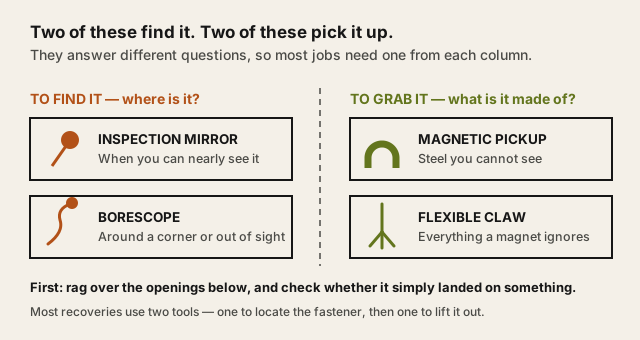
Four cheap tools cover the four ways a dropped fastener hides: magnetic for steel, a claw for the rest, a mirror to see it, and a borescope to reach deep.
Contents
A fastener vanishing into the engine bay is not a disaster, but it becomes one if you reach for the wrong tool, or start the engine, or give up and buy a replacement for something that is six inches away behind a bracket.
Four cheap tools cover the four ways a dropped item hides. Which you reach for depends on two questions: is it magnetic, and can you see it?
A note on this guide: this rests on what each retrieval tool can reach and grip, not on recoveries made here. See how we test.
First, before any tool
Stop, and do not start the engine.
A bolt resting on a subframe, a cradle or the top of the gearbox is retrievable at your leisure. The same bolt shaken into a running belt, a cooling fan or down onto an exhaust manifold is a different and worse problem. Note roughly where it fell before it has a chance to migrate, and get a light onto the area — half of these recoveries are really a lighting problem wearing a retrieval costume.
The decision, in one line
- Steel, cannot see it → magnetic pickup tool.
- Not magnetic → flexible claw grabber.
- Can nearly see it → inspection mirror.
- Around a corner or inside something → borescope.
Most jobs use two of these: one to find it, one to grab it.
This page contains affiliate links. If you buy through them, Ugly Fixes may earn a commission at no extra cost to you. Products are selected independently.
1. The magnet — for steel you cannot see
Flexible magnetic pickup tool with LED
The first tool to try on any steel fastener. The LED is secondary; the flexible shaft and magnet are the point.
See current options(opens in a new tab, affiliate link)Affiliate link. Price shown on the merchant's site.
2. The claw — for everything a magnet ignores
Flexible claw pickup tool
For non-magnetic items. A spring-loaded claw on a flexible shaft — needs to reach the object rather than attract it.
See current options(opens in a new tab, affiliate link)Affiliate link. Price shown on the merchant's site.
3. The mirror — to see the easy ones
Telescoping inspection mirror
A telescoping mirror. Fastest way to answer 'what is behind that?' before removing three unrelated parts.
See current options(opens in a new tab, affiliate link)Affiliate link. Price shown on the merchant's site.
If you would rather not evaluate that yourself, the Ullman A-2T is the one we would point at: 6 inches closed and 18-5/8 extended covers an engine bay without a second tool, and the 7/8-inch head fits between things rather than around them. One caveat worth carrying to any mirror you buy — Ullman publishes no claim that the joint holds its angle, which is the property that decides whether you end up holding it with two hands.
Ullman A-2T telescoping inspection mirror
Ullman
7/8 in head, stainless handle extending 6 in to 18-5/8 in, pocket clip. Ullman publishes no hold-angle claim — see above. Researched from Ullman’s specification, not tested.
Check price and availability(opens in a new tab, affiliate link)Affiliate link. Price shown on the merchant's site.
A telescoping inspection mirror is the cheapest and quickest way to look at anything you can light and angle a view onto — the far side of a bracket, the top of a bellhousing, the back of an alternator. It finds the object; the claw or the magnet retrieves it.
Its limit is a straight line of sight. If seeing the object needs a view around a corner or inside something, no amount of angling a mirror gets there, and that is the borescope's job.
4. The borescope — to reach around corners
WiFi / USB borescope inspection camera
A 5.5 mm tip reaches spark plug holes and ducts. Prefer a USB model — WiFi adds lag when steering by feel.
See current options(opens in a new tab, affiliate link)Affiliate link. Price shown on the merchant's site.
The tool that stops you needing any of them
Recovery is the cure. The prevention is putting the correct surface within reach before you start, because most "dropped" fasteners are not dropped — they are set down on nothing while your hands are full.
A magnetic tray beside the job is the fix, and where it fits among the other cheap essentials is in small tools that save garage jobs. Keeping the sockets themselves accounted for is the related discipline in magnetic socket organizers.
Where this fits
These four live in the same drawer as the rest of the cheap-and-quietly-essential kit — see how to organize tools in a one-car garage. And if the reason you are in there is a panel that has to come off first, trim removal tools covers doing that without snapping clips — which is its own way of scattering small fasteners into places they should not be.
Questions people actually ask
What is the first thing to do when a bolt disappears?
Which tool do I reach for first?
Why will a magnet not pick up my bolt?
Do I need a borescope, or will a mirror do?
What borescope diameter should I choose?
WiFi or USB borescope?
How do I stop dropping fasteners in the first place?
Question this page did not answer? Ask it.