Emergency & Roadside
A Jump Start That Did Not Work: What to Check
The jump failed, so the battery must be dead. Usually it is the connection, the wrong symptom read, or a pack that will not output into a flat battery.
Contents
Before concluding the battery is dead, check the connection, read the symptom properly, and make sure the jump starter is actually outputting. A jump that does nothing is more often a contact problem or a misread symptom than a battery too far gone to save.
A note on this guide: this rests on how starting circuits and lithium jump packs are specified and documented, not on failures reproduced here. See how we test.
Two safety points before the list, because they are the ones that matter. If the battery case is cracked or swollen, if there is a smell of rotten eggs, or if the car has stood in hard frost and the battery may be frozen, stop — none of those is a jump-starting problem. And make the final negative connection to an unpainted engine earth point rather than the battery post, so any spark happens away from a battery that is venting hydrogen.
The problem, as it appears
Clamps on, donor running, key turned, and nothing changes. The obvious reading is that the battery is beyond help.
Sometimes it is. More often the current never arrived, or it arrived and the fault was never about charge in the first place.
Why "the battery is dead" is the wrong first conclusion
Because a jump start tests a whole chain, and the battery is only one link in it.
Current has to leave the donor or the pack, cross two clamp interfaces, pass through cable thick enough to carry several hundred amps, cross back at two more interfaces, and then reach a starter motor through the car's own heavy cables and earth strap. Any one of those can be the failure while the battery is fine.
The symptom you hear at the key is a measurement of that chain, and it is more specific than it sounds.
The five things to check
1. The clamps are not where you think they are
This is the most common cause and the least interesting one, which is why it gets skipped.
A clamp resting on a corroded post, on the lead of the clamp bolt instead of the post itself, or on a painted bracket, makes a connection good enough for dash lights and nowhere near good enough for a starter motor. Lead oxide is a poor conductor and it forms exactly where you need the contact.
Wiggle each clamp hard. Get it onto bare metal. If the posts are furred white or blue-green, that corrosion alone can be the whole fault — the battery terminal brush is a trivially cheap tool that has rescued a lot of cars that were about to be towed.
This page contains affiliate links. If you buy through them, Ugly Fixes may earn a commission at no extra cost to you. Products are selected independently.
Battery terminal cleaning brush
Cleans post and clamp interior. The cheapest tool here and the one most likely to be the actual answer.
See current options(opens in a new tab, affiliate link)Affiliate link. Price shown on the merchant’s site. Every link here is re-checked automatically each week — one that breaks, or that lands on a storefront page instead of the product, fails that check.
2. The sound tells you which fault you have
Stop and listen before doing anything else, because the three common noises point in different directions.
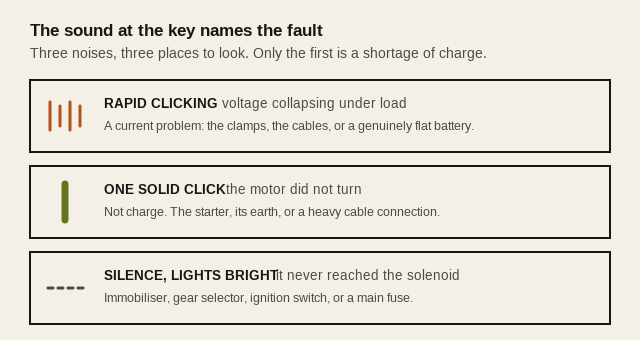
Rapid clicking is the solenoid chattering as voltage collapses under load. That is a current problem: not enough is reaching the starter, so it is consistent with a flat battery, a poor jump connection, or undersized cables.
One solid click and silence means the solenoid pulled in and the motor did not turn. That points away from charge and towards the starter itself, its earth, or a heavy cable.
Nothing at all, with bright dash lights suggests the circuit never got as far as the solenoid — an immobiliser that has not recognised the key, a gear selector not registering park or neutral, an ignition switch, or a blown main fuse. That one is a diagnosis job rather than a jump, and car electrical problems in the order to check them is the sequence for it.
3. The cables may be jewellery
Thin jumper cables with light clamps and a lot of insulation are sold on length and appearance, and they cannot carry starting current without dropping most of the voltage across themselves.
The tell is cables that get warm while nothing happens. What actually matters is conductor cross section and clamp quality rather than the printed rating, which is the subject of cheap versus heavy-duty jumper cables.
Heavy-duty jumper cables
Conductor cross section and clamp jaw are the specification. Length is the part people buy on and the part that hurts.
See current options(opens in a new tab, affiliate link)Affiliate link. Price shown on the merchant’s site. Every link here is re-checked automatically each week — one that breaks, or that lands on a storefront page instead of the product, fails that check.
4. The jump pack is refusing, not failing
Lithium jump starters almost all detect a battery before they energise the clamps, which is sensible — live clamps lying in an engine bay are a hazard. The detection usually works by looking for a minimum voltage on the terminals.
A deeply discharged battery can read below that threshold, so the pack sees nothing connected and does nothing. It looks broken. Nearly every unit has a manual override or boost mode for this case, and it is documented in the manual rather than marked on the case.
While you are there: check the pack's own state of charge. One left in a cold boot for a winter is a perfectly ordinary reason for a jump start to fail, which is the recurring argument of roadside kit for a car that might not start.
NOCO Boost Plus GB40 jump starter
NOCO
Read the manual before you need it. The override for a battery below the detection threshold is the feature you will want at the roadside.
Check price and availability(opens in a new tab, affiliate link)Affiliate link. Price shown on the merchant’s site. Every link here is re-checked automatically each week — one that breaks, or that lands on a storefront page instead of the product, fails that check.
5. You did not wait, and then you cranked too long
A severely discharged battery absorbs a great deal before it can contribute anything. Connecting and turning the key straight away is the technique error that produces a confident "it did not work".
Leave the donor running, or the pack connected, for several minutes first. Then crank in attempts of about ten seconds with real pauses between them — continuous cranking cooks the starter motor and spends whatever you just put in.
What it means if it starts and then fails again
It runs, then dies within a few miles. The alternator is not replacing what the engine uses. Belt, alternator or its wiring.
It starts all week and is flat every Monday. Something is drawing current while parked, or the battery no longer holds. Those are separable with a meter, which is what using a multimeter to find a parasitic drain is for.
It starts once and is flat by evening. Usually a battery at the end of its life that accepted a surface charge. Testing it before the next cold snap is the whole point of checking a car battery before it strands you.
The mistake to avoid
Buying a battery because a jump start failed. It is the expensive guess, and it is wrong often enough to be worth five minutes of checking first. A corroded post, a chattering solenoid or a pack that never switched on all produce the same silence as a dead cell, and only one of those is fixed by spending money at a parts counter.
Questions people actually ask
One loud click and nothing else — what does that mean?
Why will my lithium jump starter not do anything?
How long should the donor car run before trying?
Does it matter where the last clamp goes?
It started, then died again a few miles later.
Can a battery be too flat to jump?
How many times can I crank before stopping?
Question this page did not answer? Ask it.