Battery & Electrical
Should You Fit a Battery Disconnect Switch?
A knob cutting the negative terminal stops parasitic drain and deters theft. What it does not stop, the amp rating to check, and the rule that saves the ECU.
Contents
A battery disconnect switch is a knob or lever that opens the negative battery connection by hand. It is unglamorous, it bolts onto the ugliest corner of the engine bay, and for a car that sits it does two useful jobs at once: it stops the car draining its own battery, and it stops a thief driving it away.
That is the whole pitch, and like most things on this site the value is in being honest about the limits.
A note on this guide: this rests on how these switches interrupt a circuit and what they do not protect against, not on switches fitted here. See how we test.
What it does
Two things, and they are worth separating because people buy it for one and get both.
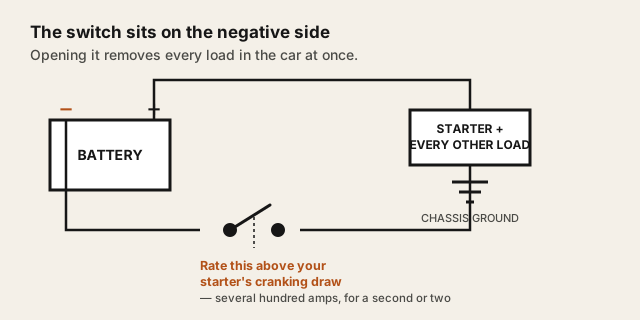
It kills parasitic drain. A car built after about 1975 is never truly off — the clock, the ECU keep-alive, the alarm and any added accessories all draw a trickle continuously, and over a season that flattens a healthy battery. Isolating the negative post removes every one of those loads at once. It is the manual, convenient version of pulling the negative terminal, which is the free fix covered in preventing a dead battery in winter storage.
It deters theft. A car whose battery is isolated does not crank. On a classic with no immobiliser that is a genuine layer of security, and knob-type switches let you remove the knob entirely and take it with you.
What it does not do
This is where the honest version diverges from the product listing.
It does not stop self-discharge. A battery loses charge inside itself whether or not anything is connected. The switch removes the car's draw, not the chemistry. Over a single winter that self-discharge rarely flattens a good battery, which is why the switch is usually enough — but it is not a maintainer, and for storage measured in many months a maintainer on mains power keeps the battery genuinely topped up rather than merely draining slowly. That trade is the subject of best battery maintainers for classic cars.
It does not fix a battery that keeps going flat in days rather than weeks. That is an abnormal draw, and the switch hides the symptom rather than finding the cause. If a healthy battery dies in under a fortnight, measure the draw before masking it — the method is in using a multimeter to find a parasitic drain.
This page contains affiliate links. If you buy through them, Ugly Fixes may earn a commission at no extra cost to you. Products are selected independently.
Battery disconnect / master switch
Confirm your battery post type and match the amp rating to your engine before ordering.
See current options(opens in a new tab, affiliate link)Affiliate link. Price shown on the merchant's site.
The two ways to get it wrong
Under-rating the switch
The switch sits in the highest-current path in the car. When you crank the engine it carries the full starter draw — several hundred amps for a second or two. A switch rated at or below that figure runs hot, and over time welds its contacts shut or fails open at the worst moment.
This is the one specification you cannot compromise on. Match the continuous and peak amperage to your engine with margin, and treat a suspiciously cheap high-amp claim with the same scepticism this site applies to jump-starter peak figures. An underrated switch in a cranking circuit is the only genuinely unsafe way to fit one.
Operating it with the engine running
Fitment, briefly
The switch has to match your battery, and the failure here is undramatic — it simply will not mount.
- Top-post batteries — the common case — take a knob switch sized for the negative cone, usually 15 to 17 mm.
- Side-terminal batteries — GM style — need a side-post switch instead.
Confirm which you have before ordering. Everything else about fitting it is the same as the terminal-cleaning job in battery terminal cleaning brushes: clean metal, a sound clamp, and the negative side done last on reconnection.
Who should fit one
A classic or weekend car that sits, where the owner is not going to fetch a spanner before every lay-up and the radio has no code worth losing. This is the clearest case, and it is most of the audience for this site.
A car parked somewhere without mains power, where a maintainer is not an option and the choice is between the switch and removing the battery entirely. The switch is far less hassle than lifting a battery out every autumn.
Who should not
Anyone whose car sits somewhere with a socket and simply wants it ready to start. A maintainer does more — it holds the battery charged rather than slowly discharging — and it needs no habit at all once connected.
Anyone driving a modern car daily who would resent losing the radio code, the clock and the seat memory every time they used it. On that car the switch solves a problem you probably do not have.
Where this fits
The switch is one option in the winter-storage toolkit, alongside the maintainer, the terminal brush and the multimeter. The whole routine — battery, moisture, brakes, tyres and the things worth not bothering with — is in classic car winter storage.
Questions people actually ask
What does a battery disconnect switch actually do?
Does it stop the battery going flat?
Will I lose my radio code and clock?
Can I flick it off while the engine is running?
What amperage rating do I need?
Top post or side post?
Is it better than just pulling the negative terminal?
Question this page did not answer? Ask it.